
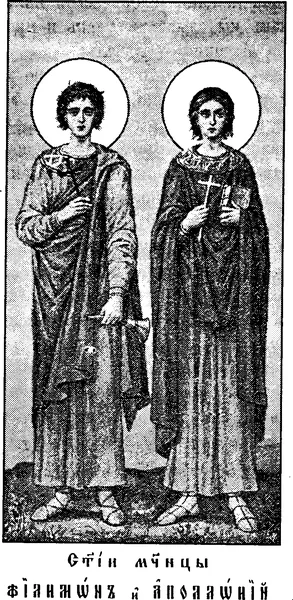
Holy Martyrs Philemon, Apollonius, Arian, Theoticus and Four Soldiers (+286–287)
The holy Martyrs Philemon, Apollonius, Arian, Theoticus and four soldiers suffered in the Egyptian city of Antinoë in the reign of the Emperor Diocletian (284–305). When the lawless autocrat began to persecute the Christians, Arian, the governor of the Thebaid, ordered that the Orthodox either be turned away from the true faith by force or be tortured to death.
At that time Apollonius, who served as a reader in the church, was seized too. He could not bear the torture and decided to resort to a trick: he gave his clothes to the pagan Philemon and asked him to put them on and offer sacrifice to the idols in his place. Philemon agreed, but when he drew near the altar, the grace of God suddenly enlightened his mind: he believed in the Lord Jesus Christ, turned his back on the idols, turned towards the governor Arian, made the sign of the cross, and fearlessly confessed Christianity.
Then Arian recognised Philemon and thought he was joking, for Philemon was his musician and entertainer. But when the governor’s faithful courtier firmly confessed Christ, Arian flew into a rage. He ordered Philemon to be put to death at once, but the people asked for the condemned man to be spared.
By this time Apollonius had already repented of his faint-heartedness and courageously confessed Christ. Then Philemon and Apollonius had their shins pierced, were bound with ropes and dragged through the streets of the city to frighten the believers. Then Philemon was hung on an olive tree and arrows were shot at him, but the arrows miraculously missed their target, and one of them glanced off and struck the governor in the eye. Arian was horrified and begged Philemon to pray for his healing. But the saint answered: “You are not ready yet. When they bury me, you will come to my grave, call on the name of Christ, and be healed.” After this, by the governor’s order, the holy Martyrs Philemon and Apollonius were beheaded (+16 March 286).
Arian, whose eye still pained him unbearably, came to the tomb of the saints, took earth from it, put it on the wound and turned to Jesus Christ in supplication. The injured eye was healed that very moment; he believed in the true God and cried out: “I am a Christian!” He was baptised with his whole household, and set free the imprisoned Orthodox. The news of Arian’s conversion reached the emperor himself. Then he sent soldiers to seize the governor and bring him to Rome. Before he was taken away to torture, Arian prayed at the martyrs’ tomb, and suddenly heard the voice of Philemon: “Take courage, Arian, and do not fear, for the Lord is calling you to Himself and preparing a martyr’s crown for you. The soldiers who have come to take you away will also believe and suffer for Christ.”
Strengthened by the grace of God, Arian boldly confessed the true faith in Rome too, before the emperor himself. The enraged Diocletian ordered the Lord’s chosen one to be bound in iron chains and buried alive, saying: “Let us see whether Christ will come to deliver him.” When after this the godless autocrat went into his bedchamber, he saw that Arian was lying on his bed, with the chains hanging before him. The martyr said to Diocletian: “You did not believe that Christ would deliver me, but behold, He has come, set me free and bidden me rest on your bed.” The king was terrified, but still he would not admit himself beaten and, hardened, ordered Arian to be killed. Through the blessed martyr’s prayer the soldiers who had brought him to Rome were converted to the true faith and boldly declared themselves Christians before the emperor. For this they were drowned in the sea together with Arian (+4 March 287).



