
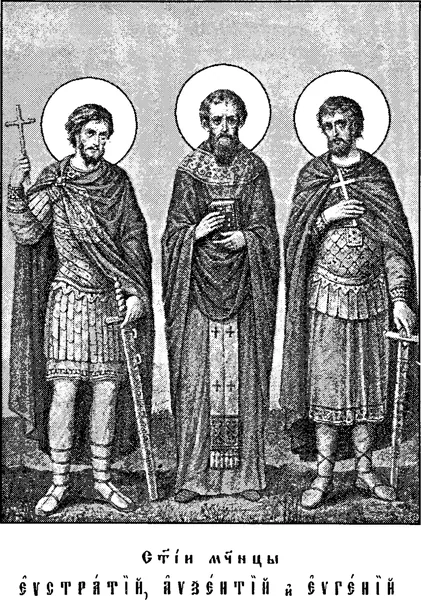
Holy Martyrs Eustratius, Auxentius, Eugene, Mardarius and Orestes (+284–305)
The holy Martyrs Eustratius, Auxentius, Eugene, Mardarius and Orestes suffered in the time of the Emperors Diocletian and Maximian (284–305). The lawless rulers sent the commanders Lysias and Agricolaus to put down the unrest and disorders that had broken out in Armenia and Cappadocia, and, since at that time every popular disturbance used to be blamed on the Christians, ordered them either to torture them to death or to persuade them to offer sacrifice to the idols.
In the city of Satalion the presbyter Auxentius was seized together with other Christians. On the day of the trial Eustratius, one of the most distinguished and wealthy officials of the city, came to the prison with his detachment and led the captive Christians out to the square of judgement. Eustratius himself was a follower of Christ, but until then he had kept his faith secret. Now the blessed one found a fitting moment and openly confessed the Saviour before the tormentor Lysias. The judge ordered the insignia of his military rank to be stripped from him at once and ordered him handed over to torture. Saint Eustratius was cruelly beaten, but he bore the torments patiently. The martyr thanked the executioner: “By the torments you have cleansed my soul from sins and prepared me for eternity.” The executioner answered: if your God could grant you immortality, He would heal you of your wounds too. No sooner had he said this than Eustratius was healed. Many who saw this miracle glorified the Lord, and Eugene, a friend of Eustratius and a soldier of his detachment, who was standing in the crowd, cried out aloud: “Lysias! I too am a Christian, like my master Eustratius!” Then he too was seized together with Eustratius and the other Christians. The next day Lysias, who was setting out for Nicopolis, ordered the captive Christians to be taken along with him. Iron boots with nails driven through the soles were put on Eustratius, so that the whole road was a terrible torture for him.
Two days later they reached Arabraca, the native town of Eugene and Eustratius. A great many people poured into the streets; they wanted to come close to Eustratius, whom they greatly loved and respected, but for fear of punishment did not dare to do so. But one poor Christian, Mardarius, showed wonderful divine zeal. He had built a new house and was working on its roof. When he noticed the prisoners, and Eustratius among them, the saint came down from the roof in haste and said to his wife: “Do you see this great man?! He did not shrink from his rank or his wealth, he left everything and offered himself as a sacrifice to the Lord! Blessed are you, Eustratius: in this world you were glorious, and in the next you will attain joy beyond words!” The woman, burning with love for Christ, answered: “What prevents you from taking the same road?” Mardarius was thinking of just that. He knelt down and prayed fervently: “O Master, God, Father Almighty, O Lord, the Only-begotten Son, Jesus Christ, and O Holy Spirit, one Godhead, one Power, have mercy on me a sinner, and by the judgements which Thou knowest save me, Thine unworthy servant, for blessed art Thou from everlasting and unto the ages. Amen.” (This prayer is still read in church today at the end of the Third Hour and at the Midnight Office.) After this the saint took leave of his God-fearing wife, kissed his little sons, and cried out aloud: “I too am a Christian!” When they heard this, he was seized at once and locked in the prison with the other prisoners.
In the morning the condemned were led out to be tried. Auxentius was the first to be sentenced to death, and he was beheaded. At night the priests of Arabraca secretly carried away the saint’s body and buried it with honour.
Then they began to torture Mardarius. The lawless ones pierced his feet, passed cords through them, hung him upside down and began to prick him with red-hot nails. The blessed one’s torture went on for a long time. At last the saint gave thanks to God: “Lord! I thank Thee that Thou hast counted me worthy of such good things. Receive my soul in peace!” And he died.
Then Eugene stood before the tribunal. First his tongue was torn out, then his hands and feet were cut off, and at last he was beheaded.
Lysias put off Eustratius’s execution for a time and hurried off to inspect the army units stationed in the city. His attention was caught by a soldier, Orestes, who stood out greatly from the other soldiers for his handsome face, his stature and his skill.
The godless commander ordered him to step forward and throw a spear at a target. The soldier took up the weapon. He was just about to carry out the order when a cross hanging on his chest came into view. Lysias asked angrily: “What is this? Are you one of those who worship the Crucified?!” “I am the servant of my crucified King and God, and I wear the Cross to protect myself from every evil!” Orestes replied. Then he too was seized and shut up with the other Christians. Following Orestes’s example, many other soldiers of his detachment also confessed the true God. Lysias threw them all into prison. Then, fearing a popular disturbance, the tormentor ordered Eustratius and Orestes to be sent to Sebaste, to Agricolaus, the governor of Armenia.
Agricolaus was cruel and merciless towards the Orthodox, but Eustratius’s wise and convincing discourse about the Lord and His inexpressible goodness softened his heart. The wrathful judge was saddened and did not sleep all night. He resolved to save Eustratius, and begged him to bow down to the idols at least in pretence, for others to see, promising him honours and gifts; but the holy martyr remained unbending.
Having lost patience, Agricolaus ordered Orestes to be laid on a red-hot iron bed. The saint went up onto the bed boldly, prayed, “Lord Jesus Christ! Into Thy hands I commend my spirit!”, and died.
At night Blaise, Bishop of Sebaste, visited Eustratius in prison and gave him the life-giving Body and Blood of Christ. At that moment a heavenly light suddenly lit up the cell, and a voice rang out from on high: “Eustratius! Thou hast finished the good fight; now come to heaven and inherit the crown prepared for thee!”
In the morning Agricolaus sentenced the Lord’s chosen one to be burned. While the executioners were preparing to carry out the sentence, the saint pronounced a prayer which was afterwards included among the readings of the Saturday Midnight Office: “Magnifying, I magnify Thee, O Lord, for Thou hast looked upon my lowliness, and hast not given me into the hands of mine enemies, but hast saved my soul from affliction; and now, O Master, let Thy hand shelter me. And let not my soul behold the darkened countenance of the evil demons, but let Thy radiant angels of light receive it.” After this the blessed martyr himself went into the red-hot furnace and committed his soul to the Lord.
Bishop Blaise buried with honour his precious body, which had remained unharmed in the fire, together with the holy bodies of Orestes and the other martyrs. Afterwards, near Constantinople, within the walls of the Olympus monastery, a church was built dedicated to the holy Martyrs Eustratius, Auxentius, Eugene, Mardarius and Orestes.



