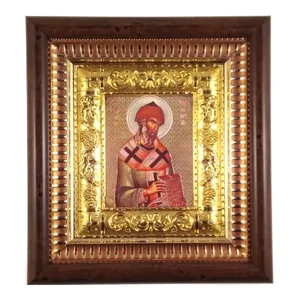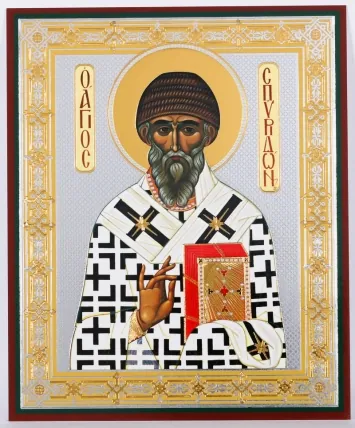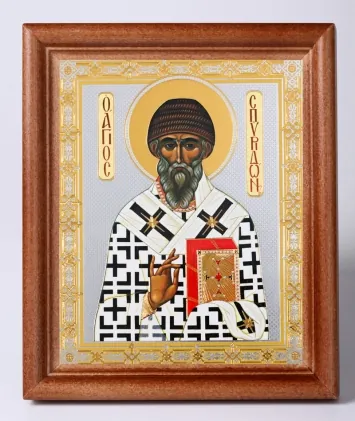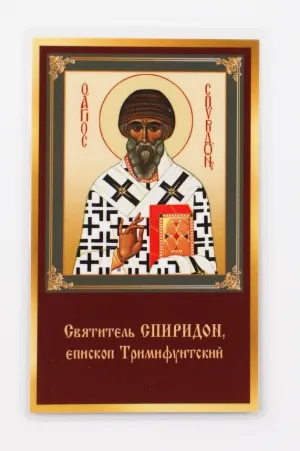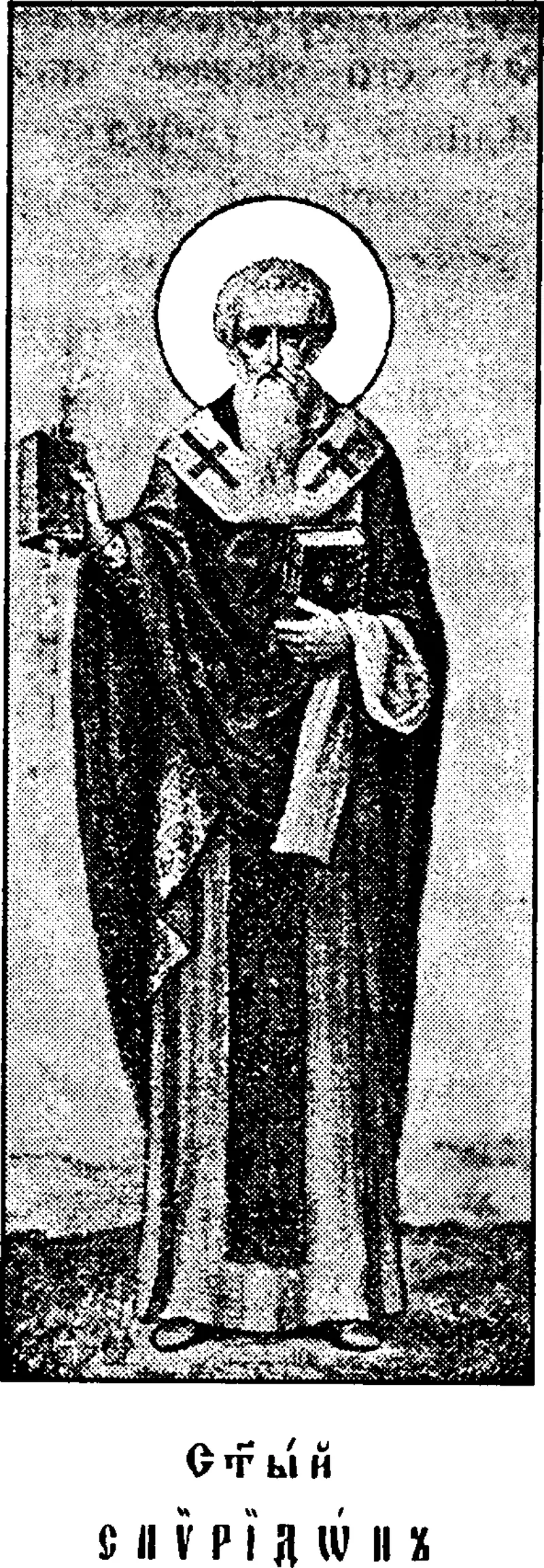
St Spyridon the Wonderworker, Bishop of Trimythous (+c. 348)
Saint Spyridon of Trimythous was born on the island of Cyprus at the end of the third century. Little information about his life has been preserved. It is known that he was a shepherd, had a wife and children, and spent all his means on relatives in need and on wanderers, for which the Lord granted him the gift of wonderworking: the blessed one healed incurable sick people and cast out demons. After the death of his wife, in the reign of the Emperor Constantine the Great (306–337), Spyridon was consecrated Bishop of the Cypriot city of Trimythous. Even after this the Lord’s chosen one did not change his way of life. According to the testimony of church historians, Saint Spyridon took part in the work of the First Ecumenical Council in 325. At the council the hierarch entered into debate with a Greek philosopher who defended the heresy of Arius. The simple word of the Lord’s chosen one showed everyone the powerlessness of human vain wisdom before divine wisdom: “Listen, philosopher, to what I shall tell you: we believe that the almighty Lord by His Word created out of nothing heaven, earth, man and the whole visible and invisible world. This Word is the Son of God, who for our sins came down from heaven, was born of a Virgin, lived among men, suffered, was buried and then rose again, having redeemed original sin by His Passion and raised up the whole human race together with Himself. We believe that He is consubstantial and equal with the Father.” After his conversation with the hierarch, the enemy of Orthodoxy became its zealous defender. He said to his friends: “As long as they contended with me by arguments, I put forward other arguments and overcame my opponent by the art of debate; but when, instead of proofs proceeding from reason, some special power poured forth from the old man’s lips, my word became powerless, for man cannot stand against God. If any of you can think as I think, let him believe in Christ and follow, together with me, this old man, through whose lips the Lord Himself spoke.”
The hierarch cared for his flock with love. Through his prayers drought gave way to life-giving rain, and after incessant rains the sky cleared; the sick were healed and demons were driven out. Once a woman came to the saint with a dead infant lying in her arms and asked for help. The blessed Spyridon prayed and restored the child to life. The mother could not bear the shock of joy and fell down lifeless, but through the prayer of the Lord’s chosen one she too came back to life. Once a friend of Saint Spyridon was unjustly tried and sentenced to death. The blessed hierarch went to the city to save him. On the way the saint stopped a flooded river in the name of Christ. The judge, who had already learned of the miracle that had taken place, received Saint Spyridon with honour and released his friend.
The following incident from the life of Saint Spyridon is known: once he went into an empty church, ordered the lamps and candles to be lit, and began the service. When he said, “Peace be unto all”, he and the deacon heard from above the unearthly sweet voice of a large and harmonious choir: “And to thy spirit.” To every petition of the litany the invisible choir answered: “Lord, have mercy.” The wondrous voice coming from the church drew the people who were nearby. They hurried towards the church. The nearer they came to the house of the Lord, the stronger the voice grew. But when they went into the church, they saw no one apart from the bishop and a few clergy, and the heavenly singing stopped, which amazed them all.
Saint Symeon Metaphrastes, who wrote the life of the blessed Spyridon, compares him in hospitality to the patriarch Abraham. And Sozomen in his “Ecclesiastical History” tells this wonderful story from the holy hierarch’s life: Great Lent had just begun when a wanderer came to the house of Spyridon of Trimythous. The traveller looked very tired, and so the hierarch said to his daughter: “Wash the guest’s feet and prepare a meal for him too.” His daughter answered that there was neither bread nor flour in the house. Then Saint Spyridon apologised to the guest and told his daughter to roast some salted pork that had been put by. The hierarch called the wanderer to the table and began to eat. The latter declared that he was a Christian and refused the dish offered. But the host answered: all the more should you not refuse, for the Lord has said: “Unto the pure all things are pure” (Titus 1:15).
Another story told by Sozomen is also very characteristic of Saint Spyridon. The blessed one had the custom of distributing part of the harvest he gathered to the poor and lending out another part. The hierarch himself handed out nothing; he would only point to the granary, where everyone could take as much as he wished, and then return it in the same way, without supervision.
According to Socrates Scholasticus, thieves once planned to steal Saint Spyridon’s sheep and crept into the sheepfold in the dark of night, but an invisible power bound them there. In the morning the hierarch came to the flock, set the robbers free, and persuaded them to abandon their lawless life and earn their bread by honest work. And at last he gave each of them a sheep.
The whole life of Saint Spyridon shone with wonderful simplicity and with miracles worked by the power of the Lord. The blessed Spyridon spent his earthly life in righteousness and holiness, and reposed in peace around 348. The holy relics of the Lord’s chosen one, apart from his right hand, which is kept in Rome, rest on the island of Corfu, in the church dedicated to him. The Church also commemorates the holy hierarch on Cheesefare Saturday.