
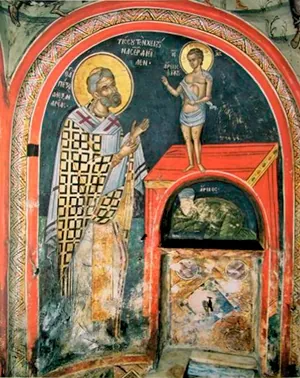
Hieromartyr Peter, Archbishop of Alexandria (+311)
Once the Apostle Peter set out by sea for Syria together with his new disciple. On the way the saint told his teacher about his childhood. Meanwhile the travellers drew near a small island. This was the very island on which Matthidia lived. Going ashore, Peter met a poor woman begging for alms; by God’s providence the apostle recognised Matthidia in the destitute woman, told her that he knew her youngest son, and took the woman aboard the ship. Matthidia recognised her son from afar. In conversation it came out that Faustus and Faustinian, who were waiting for the Apostle Peter in Laodicea, were Saint Clement’s brothers, and mother and son waited impatiently to reach Laodicea.
When Peter and his companions arrived in Laodicea, Faustus and Faustinian came out to meet them.
The holy apostle left the happy family and continued his journey. On the way he met a man of dignified appearance but poorly dressed, who seemed to have been waiting for him on purpose. The man came up to the saint and said to him: “I see that you are a sensible man, and I want to give you some advice. This morning I watched you go down to the seashore and pray for a long time. I do not want you to labour in vain, and so I wish to prove to you that there is no God, either in heaven or on earth, and that no one cares for us.” Peter treated the man who had lost his way with understanding and preached the true God to him. The stranger told him the story of his life, and the overjoyed apostle learned that the Lord had shown him Clement’s father. Peter brought Faustus too to the wife and children he had not seen for so long.
Faustus, Matthidia and their sons settled in Rome and lived in honour and glory. They gave generously to the poor and tried to spread the word of God. Some years later the parents reposed in peace, while their sons continued to preach the Gospel. Clement was distinguished by particular zeal; he did not leave the Apostle Peter while he was in Rome. Before his death the blessed teacher consecrated him bishop.
In the hardest time of the persecution of the Christians, Saint Clement wisely governed the flock of Rome. He set apart seven writers who recorded the labours of the holy martyrs and so preserved most precious information for us. Pope Clement converted many to the faith of Christ. The pagans, seeing the hierarch’s successful apostolic work, denounced him to the Emperor Trajan (98–117), saying that he insulted the pagan gods. The godless autocrat banished the Lord’s chosen one from the capital and sent him to the Crimea, to work in the stone quarries of Inkerman near the city of Chersonesus (present-day Sevastopol). Many of the saint’s disciples chose voluntary exile rather than separation from their teacher, and went with the blessed hierarch. On reaching the place of exile Clement found there many Christians who had been sentenced to work in the harshest conditions and were deprived even of drinking water. The saint prayed together with the condemned men, and the Lord showed them a spring from which a whole river flowed out. This miracle drew many people to Pope Clement. Under the influence of his preaching countless pagans were converted to the law of Christ. The believers managed to carve out a church in the stone quarries, in which the blessed Clement celebrated the services. The saint’s apostolic labour enraged the Emperor Trajan, and he ordered the blessed chief shepherd to be drowned. Then the lawless ones tied an anchor round the neck of the Lord’s chosen one and sank him in the Black Sea. This happened in 101.
Through the prayer of the hierarch’s faithful disciples Cornelius and Phoebus, and of the whole people, the sea drew back, and the believers saw the incorrupt relics of their teacher lying in a marble church miraculously carved out under the water (“the church of the angels”). After this, every year on the day of the hierarch Clement’s martyrdom the sea drew back, and the Christians were able to venerate the holy relics for seven days. By God’s permission, only in the ninth century, in the reign of the Emperor Nicephorus (802–811), were Clement’s holy relics hidden from the eyes of the faithful: for fifty years the sea did not reveal the church lying in its depths. When Cyril and Methodius, Equal to the Apostles, who had come to Chersonesus in the reign of the Emperor Michael III (855–867) and his mother Theodora (842–855), learned of this, they stood in prayer together with the local Bishop George and the whole people for the holy relics to be revealed. After Bishop George had prayed fervently together with Cyril, Methodius, the clergy who had come from Constantinople, and the people, at midnight the relics of the blessed Clement miraculously floated up to the surface of the sea. They were translated with honour to the Church of the Holy Apostles. Cyril and Methodius carried some of the hieromartyr’s relics to Rome, and his precious head was translated to Kiev by Vladimir, Equal to the Apostles (+1015).
The hierarch Clement left us two Epistles to the Corinthians, the first written monuments of Christian teaching after the writings of the apostles.
The Hieromartyr Peter, Archbishop of Alexandria, was born and brought up in Alexandria. A deeply learned father, he headed the school of Alexandria. In 300 he received the helm of the Church of Alexandria from his teacher and spiritual father, Saint Theonas. During the persecution of the Christians by the Emperors Diocletian and Maximian (284–305), the blessed Peter was driven out of the city. He travelled round many regions of the empire, and at last returned to his native city, so as to guide the Church of Alexandria in person in the time of trial. The hierarch secretly visited Christians shut up in prison, helped widows and orphans, preached the word of God and celebrated divine services. And the Lord protected His chosen one from his persecutors.
In spite of persecution and oppression, the Church of Alexandria grew stronger and larger under the wise guidance of Peter of Alexandria. At last, by order of the Emperor Maximian Galerius (305–311), the hierarch was seized. The whole people gathered at the prison gates to help the hierarch. Saint Peter, wishing to avoid a popular uprising and bloodshed, proposed to the authorities in writing that they break through the back wall of the prison and take him out secretly from the people to be put to death. In the dead of night the holy chief shepherd was led out beyond the city wall and beheaded on the very spot where the holy Apostle Mark had once been put to death. This happened in 311. In the morning the city learned of the holy hierarch’s martyrdom. The believers carried the body of the God-pleaser into the church, clothed it in hierarchical vestments, and during the funeral service seated it on the high place. In his lifetime Peter would sit only at the foot of it, because, as he himself said, he saw a divine light surrounding that place and did not dare to go up onto it.
Peter of Alexandria, a great champion of Orthodoxy, is known as a profound theologian and church writer.



