
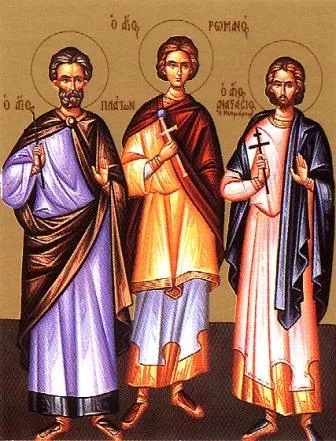
Holy Martyr Plato (+302 or 306)
The holy Martyr Plato, brother of the holy Martyr Antiochus the Physician (commemorated 16 July), was born in Ancyra of Galatia, into a family of pious parents. While still a youth he left his parental home and took up an apostolic labour: the blessed one went from city to city, filled with the grace of the Holy Spirit, preaching the teaching of the Gospel among the pagans, and amazing his hearers with his persuasive eloquence and his deep learning in Hellenic letters. For this he was seized and brought to the temple of Zeus, before the tribunal of the governor Agrippinus. At first the judge tried to persuade the saint by flattery to deny Christ, assuring him: if you worship the pagan gods, you will equal the great philosopher Plato himself in wisdom. To this Saint Plato answered: the philosopher’s wisdom is great, but passing and limited; true, eternal and boundless wisdom is contained only in the teaching of the Gospel. At the price of denying the Saviour the judge offered the saint his charming daughter in marriage, and in case of disobedience threatened him with torture and death. The blessed Plato replied: I choose a passing death for the sake of eternal life. Enraged by the confessor’s boldness, the governor ordered the saint first to be beaten mercilessly and then to be thrown into prison. A great crowd of people gathered at the prison gates. Among them were Orthodox believers too, and the Lord’s chosen one addressed them in a loud voice: “Know, brethren, that I suffer not for any crime, but for confessing the true God, the Creator of the whole world. I beseech you, Christians, do not let my sufferings dismay you; ‘Many are the afflictions of the righteous: but the Lord delivereth him out of them all’; let us stand firm on the unshaken rock of the faith and not be afraid of suffering for piety, for the sufferings of this present time are not worthy to be compared with the glory prepared for us.”
A week later Saint Plato was again brought before Agrippinus’s tribunal in the temple of Zeus, where the instruments of torture had already been made ready: boiling cauldrons, a red-hot iron bed, sharp hooks. The saint was offered the choice either to offer sacrifice to the idol or to experience the action of these instruments on himself. This time too the blessed martyr firmly refused to do what they demanded. Then tortures were again brought down upon him, and after that he was thrown into a cell and kept there for eighteen days without food or drink. When the lawless ones saw that even so they could not bend the saint’s will, they put a cunning proposal to him: they promised him life and freedom if he would say: “Great is the lord Apollo.” “I do not wish to sin even in word,” the valiant confessor replied. By the tormentor’s order the blessed Plato was beheaded (+302 or 306).



