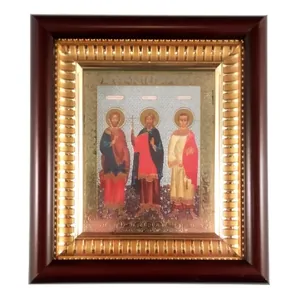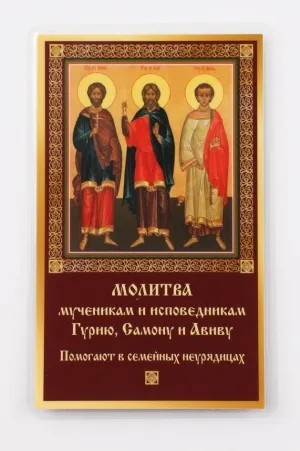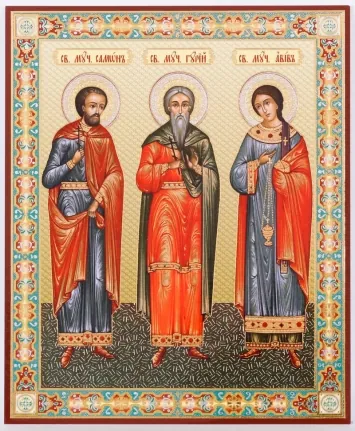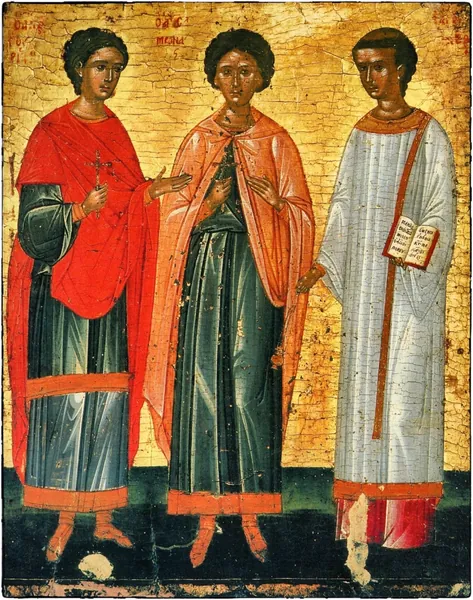
Holy Martyrs and Confessors Gurias, Samonas (+299–306) and Habib (+322)
The holy Martyrs and Confessors Gurias, Samonas and Habib. Saints Gurias and Samonas were born in the city of Edessa (Mesopotamia). Burning with love for Christ, the saints went out into the desert to labour, and converted many pagans to the Orthodox faith. When the emperors Diocletian and Maximian (284–305) began to persecute the Christians, the Lord’s chosen ones were seized and ordered to offer sacrifice to the idols. The saints answered the godless with a firm refusal, for which terrible torments fell upon them; but Gurias and Samonas bore everything patiently and fervently besought the Lord for help. One of the witnesses of the blessed ones’ martyrdom preserved for us the words of their prayer: “O Lord our God, without whose will not even one sparrow falls into the snare; Thou who didst enlarge the heart of David in affliction, didst show the Prophet Daniel stronger than the lions, and didst keep the Hebrew youths unharmed from the executioners and in the furnace: do Thou now too, O Lord, who knowest the weakness of our nature, look upon us with the eye of mercy, and keep among us the unquenchable lamp of Thy commandments. Direct our steps by Thy light, and make us worthy to attain Thy blessedness, for blessed art Thou unto the ages of ages.” By night the martyrs were taken outside the city and beheaded (+299–306). The Christians buried their holy remains with honour.
The pagan Emperor Licinius (307–324) began to persecute the Christians again. The tormentor ordered that Habib, a deacon of the Church of Edessa, be seized too for spreading the true faith. The Lord’s chosen one did not wish other Christians to fall victim to the search for him, and so he presented himself before the executioners at the tribunal. The godless sentenced him to be burned. Christ’s valiant ascetic walked into the fire himself and committed his soul to the Lord in prayer (+322). When the fire had gone out, the martyr’s mother and relatives saw his remains completely unharmed; they glorified the Lord and buried the holy body with honour beside the relics of Saints Gurias and Samonas.
After the saints’ repose many miracles took place through prayers offered to them with hope. So, for example, a Gothic soldier stationed in Edessa once married a devout maiden, Euphemia. Before the wedding, at the tomb of the holy Martyrs Gurias, Samonas and Habib, he swore to the girl’s mother Sophia that he would never fail in love and honour towards his wife. When his service in Edessa was over, the soldier took Euphemia with him and returned to his homeland. It soon became clear that he had deceived the girl: he had another wife in his homeland, and Euphemia became her servant. The deceived woman had to endure much mockery and humiliation. When she had a child, the Gothic woman, beside herself with jealousy, made her drink poison. Euphemia with fervent prayer asked the help of Gurias, Samonas and Habib, the witnesses of the deceitful soldier’s oath. After her prayer Euphemia not only escaped death by poisoning, but found herself, together with her child, miraculously in her native city of Edessa. Some time later the oath-breaking Goth came again to Euphemia’s city. Sophia publicly exposed the lawless man’s wickedness, for which, by the governor’s order, he was put to death.