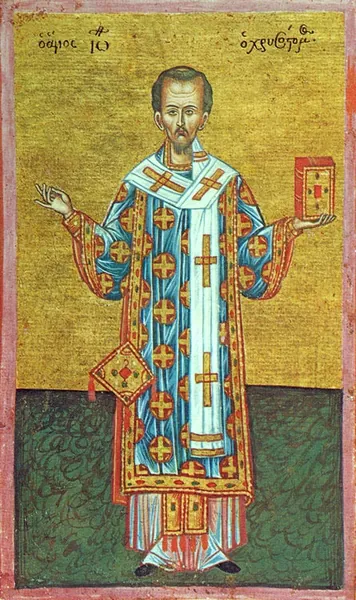
Saint John Chrysostom, Archbishop of Constantinople (+407)
Saint John Chrysostom was born in Antioch around the year 347. His parents, Secundus and Anthusa, were distinguished and God-fearing people. Secundus held the post of military commander and enjoyed great respect at the royal court, but he died early, and the whole upbringing of the boy John fell on the shoulders of his mother, who was widowed very young, at twenty. Anthusa instilled in her son the spirit of Christian piety, and at the same time gave him a secular education under the guidance of well-known scholars of the day. At eighteen John set out for Athens to complete his education. There by his wisdom and learning he soon surpassed all his fellows and many philosophers too, for which he also made enemies among the envious. Even at that time many pagans were converted to the law of Christ by the saint’s preaching. The archbishop of Athens resolved to ordain him priest and appoint him his successor. When John learned of this, he secretly slipped away from Athens and returned to his native Antioch.
In Antioch Saint John lived in seclusion; nothing of this world attracted him, and with his friend Basil (afterwards bishop of Raphanea) he wished to become a monk. Then his mother, Anthusa, reminded him that she had no one left in this world to comfort her, and asked him: do not leave me while I am alive. John heeded his mother’s request and put off his intention for a time, but even at home he lived like a hermit and spent all his time in fasting and prayer. During this period John came close to the Patriarch of Antioch, Saint Meletius, who baptised him and appointed him a reader in the church. Three years later Anthusa died. John buried his mother with honour, and then gave away all his property to the poor, freed his slaves and withdrew into a monastery, where he spent his days in strict ascetic labour. Here Saint John wrote his works “On the Priesthood”, “On Compunction of Heart” and the “Letter to Theodore”.
One night one of the monks living in this monastery, Eusebius, saw two apostles in shining garments come to John: John and Peter. John held a scroll in his hand, and Peter keys. John the Theologian handed him the scroll and said:
“The Lord grants thee the deepest wisdom, that thou mayest teach the flock of Christ and silence the heretics!”
And Saint Peter handed him the keys:
“I am Peter, who holds the keys of the Kingdom. The Lord gives thee too the keys of the Church, that whomsoever thou loosest may be loosed, and whomsoever thou bindest may be bound.”
John fell at the apostles’ feet and cried out:
“Who am I, the least among men, that I should take upon myself so great and hard a work?”
But the apostles raised him up and said to him:
“Arise, take courage, and do that to which the Lord Jesus Christ calls thee. Preach the word of God to the people and do not fear difficulties: God has willed that through thee many souls shall be converted to the law of Christ and come to know the true God. Know too that for preaching the truth many trials await thee, but endure them courageously, for by this way thou shalt inherit the Kingdom of Heaven.”
The saint continued to live in the monastery and laboured tirelessly for the salvation of his soul; soon he became known as a wonderworking father, and a great many people came to him to receive healing and to hear his soul-profiting talk. To escape the glory of men, Saint John withdrew still further, into a cave. He lived there two years, but his strict labours made him so ill that he no longer had the strength to look after himself, and he was obliged to return to Antioch. This too happened by the providence of God, so that many pagans might be converted to the law of Christ by his preaching and many Christians strengthened in the faith. The Patriarch of Antioch, Saint Meletius, received John with great love, ordained him deacon, and for six years kept him at his side. Many of John Chrysostom’s works belong to this period.
When Saint Meletius died, John went back to the monastery where he had laboured before and spent another three years there. At this time the Patriarch of Antioch was Flavian, to whom once at night, during prayer, an angel of the Lord appeared and commanded him to go to the monastery where John was labouring and bring him back: from now on the saint was to preach the teaching of Christ publicly. At the same time John too saw a vision: an angel commanded him to obey Flavian. And indeed the patriarch himself came to the monastery, where the monks received him with great honour and led him into the church. The patriarch celebrated the Liturgy and announced to the brethren that he must take John with him. Parting from Saint John grieved everyone, but they obeyed the will of God without a word.
On the very day after their arrival in Antioch John Chrysostom was ordained priest. During the ordination everyone saw a miracle: a white dove, flying in from somewhere, circled over Saint John’s head. From then on the pastor set about caring for his flock with great zeal: twice a week, and sometimes every day, he taught the people from the ambo. Saint John diligently explained Holy Scripture to the people, for he considered this work most needful and necessary. He left us commentaries on the books of the Old Testament, on the Gospels of Matthew and John, and on the Acts of the Apostles; he especially loved the epistles of the Apostle Paul and often explained them.
Not everyone who wished could hear Saint John’s sermons because of the crowds, and so many wrote down his words and passed them on to one another. These words were read at meals and in the squares, and people learned them by heart. When they heard that John was preaching somewhere, everyone hurried there: city governors and judges left their business, merchants their trade, craftsmen their workshops; everyone hastened to hear John and tried not to miss a single word of what he said. That is why the saint was called “sweet-speaking”, “honey-flowing”, and at last “Chrysostom” (Golden-mouth). Saint John tried to make his words equally understandable to the learned and the simple; he preached tirelessly and always found a word of comfort for his flock.
Meanwhile Nectarius, Patriarch of Constantinople, died, after which for a long while no successor could be found. At last Arcadius, the Byzantine emperor, dispatched a courier to Flavian and ordered him to send John Chrysostom to Constantinople. Antioch was plunged into deep grief. The people would by no means part with their beloved teacher. Everyone gathered in the great church of Antioch and, in spite of Flavian’s admonitions, would not let the king’s envoys take Saint John away. Nor did John Chrysostom himself wish to go: he did not consider himself worthy to be patriarch. Then the king was filled with still greater curiosity: he wanted to see who this man was who had won such love from the people. He ordered his servants to spirit Saint John secretly out of Antioch, and this they did.
When John Chrysostom drew near Constantinople, the whole city came out to meet him, and the king too received him with honour. Soon a church council was held, at which John Chrysostom was elected Patriarch of Constantinople. His enthronement took place on 21 February 398. The king with his nobles came to the patriarch to receive his blessing. The patriarch blessed the king and wished him to keep the holy Orthodox faith firmly, to avoid dealings with heretics, to go to church often, and to be merciful and just. John Chrysostom laboured diligently for the good of his flock’s souls; he mercilessly rebuked evil habits, foulness, envy, greed, adultery and every kind of impurity. He preached love, mercy, moral purity and justice, and called everyone to a life pleasing to God.
Once, in the days before Easter, John Chrysostom was wounded by the unseemly behaviour of the people, the very people whom he loved so much and for whose spiritual progress he cared so much. On Wednesday of Passion Week a violent storm arose, which threatened to flood the city. The people were frightened, repented and flocked to the churches. But as soon as the danger had passed, they at once forgot the stern warning, and on Saturday gave themselves again to unbridled merriment: they made for the circuses and theatres and began to hold feasts. Shaken to the depths of his heart, on the first day of Easter John addressed his ungrateful flock in his famous discourse “Against the Games”.
John Chrysostom cared not only for Constantinople but for the surrounding country too. To the nearby cities he sent experienced teachers to preach the divine law and strengthen Christianity. He utterly destroyed the heathen altars that had stood for centuries in Phoenicia, converted to the law of Christ the Celts, who had earlier been led astray by the Arians, and Christianised the Scythians along the Danube; in short, he enlightened the whole world with the light of faith. Saint John cared especially for the infirm and the poor. He built many hospitals and shelters for the homeless, appointed servants and physicians for them, and helped them unceasingly by word and deed.
Once the holy hierarch went to Asia Minor, for he knew that the sin of simony was widespread in the Church there (simony: the buying and selling of priestly rank). The saint exposed this lawlessness, severely punished the guilty priests and bishops, and appointed worthy men in their place. After this he returned to Constantinople.
In spite of his high rank John Chrysostom never gave up strict monastic labour: he spent all his free time in solitude, prayer and fasting; he slept little, ate little, and never went to feasts or shows.
Saint John mercilessly rebuked the sins of the great, their avarice, greed and injustice, and threatened them with God’s wrath for their lawless deeds. For this he reaped the enmity of many nobles: the saint’s words only irritated them, for they did not wish to give up their sins and found it hard to hear themselves rebuked. They slandered the saint, tried to ruin his name in the eyes of the people and somehow get rid of him. In spite of this the saint’s fame grew ever greater, and many came from distant lands to hear him. Among John Chrysostom’s enemies one was exceedingly powerful: the Empress Eudoxia. She was possessed by a terrible passion of greed and avarice; she stopped at nothing to amass wealth, and seized her subjects’ property by force or by deceit: every sermon of John Chrysostom’s in which he rebuked greed the empress took as aimed at her personally, and she hated him bitterly. Eudoxia resolved to get rid of the patriarch whatever it might cost. Among the saint’s enemies were also Theophilus, Patriarch of Alexandria, several bishops, and those priests whose enjoyment of a lawless life was hindered by the saint’s preaching.
Then Theophilus of Alexandria convened a council in Constantinople, which condemned Saint John in his absence and deposed him from the patriarchate. The king, won over by the empress, agreed to the decision of this council and ordered the saint to be banished. The people, indignant at the news, gathered at the church; they denounced the king and queen and defended their hierarch. For three days no one could come near the church. But Saint John did not wish a new charge to be brought against him, namely that he was disobeying the king’s order; so he slipped quietly out of the church and gave himself up to the soldiers himself.
When the people learned of this, they made to stone Bishop Theophilus. Theophilus was afraid and fled hastily from Constantinople. The people surrounded the king’s palace and demanded the saint’s return. That same day there was a great earthquake, which frightened the Empress Eudoxia, and she asked the king to bring back the patriarch. Boats criss-crossed the Sea of Marmara: the king’s messengers were offering Saint John his return. The hierarch agreed. The people of Constantinople came out with lighted candles to meet their patriarch, and soon the sea was filled with torch-lit boats. When they entered the city, the people led him with great honour, singing psalms, into the church. The saint offered a prayer to God and then addressed the people, who listened to their beloved hierarch with hope. The people rejoiced, while the saint’s enemies scattered.
The patriarch continued his ministry, but the peace did not last even two months. Near the church of Hagia Sophia the Empress Eudoxia set up a tall column with her own image, and held great festivities and games at its unveiling. The noise reached the church and disturbed the celebration of the Divine Liturgy. Saint John asked the head of the city to stop the unbridled festivities, but he paid no heed to the patriarch’s words. Then Saint John delivered in the church a stern sermon of rebuke, which began thus: “Again Herodias rages, again she is troubled, again she dances, again she seeks the head of John!”
This was reported to Eudoxia at once, and she was told besides: by Herodias he plainly means you. The empress flew into a rage and with tears begged the king to summon a council against John Chrysostom a second time. Again letters were sent to all the bishops who had taken part in the earlier council, and again the saint’s enemies gathered. Only Theophilus, Patriarch of Alexandria, did not appear, for he remembered well how the previous council had ended for him, though he sent three bishops in his place. The lawless council condemned Saint John again.
As Easter drew near, the king, on the advice of certain bishops, sent word to John Chrysostom:
“Leave the church, since two councils have condemned you! I cannot enter the church while you are there!”
John answered:
“Jesus Christ entrusted the Church to me, and I cannot abandon it of my own will. Let your servants come and remove me by force; then I shall no longer have to answer before Christ for abandoning the Church of my own accord.”
At first the king hesitated, but then, urged on by the patriarch’s enemies, he did send one of his commanders, Marinus, to the church, and ordered him to remove the patriarch from the church by force. Until the order for his exile should come, he was allowed to remain in the patriarchal residence for two months. During this time many trials came upon the saint through the scheming of his enemies. Twice they sent hired murderers to the hierarch, but the house was vigilantly guarded by the patriarch’s faithful people, who saved the hierarch.
On the day of Pentecost Saint John was handed the order that he was to go into exile. One of the nobles advised him to leave the city secretly, to avoid unrest among the people and bloodshed. Then the saint called together several faithful bishops and clergy, and also the deaconess Olympias, and bade them farewell. Everyone wept, and Saint John himself wept: they felt that they were parting from one another for ever. Soon the hierarch secretly left the house and made his way to the seashore, where soldiers were waiting for him: they put the saint in a boat and sent him on his way.
After Saint John’s banishment a great fire broke out in Constantinople, plainly a manifestation of the wrath of God. Many buildings burned, great wealth was destroyed, and the palace where the councils against John Chrysostom had been held burned down, but the people remained unharmed. The saint’s enemies declared that the fire had been started by his supporters.
Meanwhile Saint John Chrysostom was travelling to his place of exile. The soldiers escorting him beat and tormented him cruelly, carrying out the empress’s order: Eudoxia wished the hierarch to depart this life as soon as possible. The soldiers put the saint on a donkey and drove him on with all their might, allowing him no rest; they made him spend the nights in the filthiest inns, starved him, would not let him enter the churches, and heaped abuse on him. Monks they met on the way wept bitterly at the sight of the sufferings of this great father.
When the saint reached the city of Cucusus in Lesser Armenia, the bishop of that city, Adelphius, who had been told beforehand in a vision of the guest who was to come, received him with great honour. In Cucusus he converted many unbelievers by his preaching; people came from every side to hear him, and his old acquaintances and admirers came even from Antioch. The news reached Constantinople. The saint’s enemies were alarmed: to them John Chrysostom was dangerous even in exile. Soon an order came to Cucusus that he was to go still further, to the shore of the Black Sea, to the city of Pityus (Bichvinta). The saint’s sufferings began again: the soldiers treated the prisoner more cruelly than before; they avoided villages and towns so that he should have no chance to rest, and drove the donkey on which Saint John sat mercilessly through heat and wind. This journey finally broke the saint’s strength. One night the holy Apostles John and Peter appeared to him again, told him of his approaching end, and said too that the empress would be severely punished for her crime. Saint John was accompanied by two priests and a deacon, devoted to the saint, who saw the holy apostles with their own eyes and glorified God. In a few days they reached Comana (Georgia, Abkhazia). Near this city stood a church of Saint Basiliscus (Saint Basiliscus was a bishop and suffered martyrdom in the time of the Emperor Maximian). The travellers spent the night by the church. In the night Saint Basiliscus appeared to John and said to him: “Take courage, brother John! Tomorrow we shall be together!”
The sarcophagus of Saint John Chrysostom at Comana (Abkhazia)
The next day Saint John went into the church, put on the vestments of a hierarch, and gave his own clothes to those accompanying him; then he celebrated the Divine Liturgy, received communion, blessed everyone, bade everyone farewell, and with the words “Glory to Thee, O God, for all things” committed his soul to the Lord. This happened on the day of the Exaltation of the Cross, in 407, when Saint John Chrysostom was sixty years old. He had governed the Church of Constantinople for six years, and spent three years in exile.
The priests and deacon who had accompanied the saint mourned the hierarch’s death bitterly. Soon they set out for Rome, to Pope Innocent, and told him in detail of the saint’s persecution and end. Innocent sent Arcadius a stern letter, in which he wrote: “You have banished the true shepherd and delivered his flock into the hands of strangers. But the just God will punish you for this crime, as He punished Cain for the murder of his brother Abel!”
For his part, Honorius, the emperor of Rome, wrote his brother a letter full of reproach. As a result of all this Arcadius was seized with terrible fear and trembling; he repented of what he had done, sought out all who had fought against John Chrysostom, and put some to death and stripped others of the honour of the priesthood. The bishops who had taken part in the lawless council and in the persecution of John Chrysostom he put in prison. Nor did the empress escape punishment: the king put her away, shut her up in a separate palace and forbade everyone to have any dealings with her.
God Himself repaid the saint’s enemies: on some He sent terrible diseases, on others sudden death; some were struck dumb, and Theophilus, Patriarch of Alexandria, went out of his mind and died so. The wrath of God overtook the Empress Eudoxia too: she began to bleed heavily, worms swarmed over her, and she gave off such a terrible stench that no one could come near her. The physicians could do nothing for her illness. Then Eudoxia herself told them: you cannot help me; God is judging me because I persecuted Patriarch John. She returned the property she had unjustly seized to its owners, but even so nothing helped her illness, and Eudoxia soon died. To expose her lawlessness, the coffin in which Eudoxia lay shook for thirty-two years, until the Emperor Theodosius, the son of Arcadius and Eudoxia, translated the saint’s relics from Comana to Constantinople (this happened on 27 January 436). Then the emperor besought Saint John to forgive the empress her terrible sin. The saint heard him, and from that time Empress Eudoxia’s coffin stopped shaking.
So God punished the saint’s enemies, while Adelphius, bishop of Cucusus, who had once received Saint John with love, was counted worthy of this vision: an angel led him into paradise and showed him the place where all the holy fathers and teachers of the Church were. Adelphius looked for Saint John, but could not find him anywhere, and came out saddened. The angel asked him:
“Why are you downcast? Everyone who comes in, even if he was sorrowful, goes out joyful; but you do the opposite: you came in joyful and are going out with a sorrowful face!”
Adelphius answered:
“What grieves me is that I did not see my beloved teacher John anywhere among these holy fathers.”
“You mean, no doubt, John the preacher of repentance?”
“Yes,” answered Adelphius.
“No man in the flesh can see him, for he stands before the throne of the Lord with the Cherubim and Seraphim,” said the angel.
Adelphius rejoiced and gave thanks to God for revealing this mystery. Saint John Chrysostom, the great God-pleaser, who endured many sufferings for Christ, rests in the Kingdom of Heaven, while his writings have helped the faithful for many centuries on the way of salvation and help them still: they raise up the fallen, encourage the despairing, comfort the mourning, and open the door of repentance to sinners.