
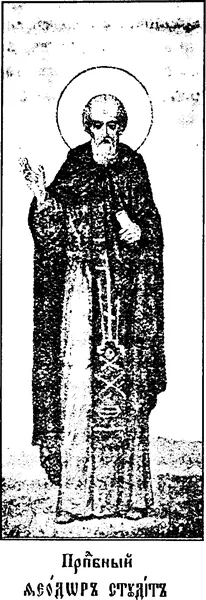
Venerable Theodore the Studite, the Confessor (+826)
The Venerable Theodore the Studite was born in 785 in Constantinople, into the family of devout Christians: Photinus, a collector of the royal taxes, and his wife Theoctista. He received a serious education from the best rhetors, philosophers and theologians of the capital.
At that time the heresy of the iconoclasts spread widely in the empire, and the lawless Emperor Constantine Copronymus (741–775) also favoured it. The views of the iconoclast autocrat and his court were utterly contrary to the religious feelings of Photinus, a faithful defender of Orthodoxy, and for this reason he left the state service. After this Saint Theodore’s parents, by mutual agreement, shared out their estate among the poor and became monastics.
The blessed Theodore became widely known in the capital through his part in the disputations on the veneration of icons, which were held quite often at that time. His perfect art of oratory, his free command of philosophical terminology and logic, and above all his deep knowledge of Christian dogma brought convincing victories to the holy father, who fearlessly exposed the heresy of the iconoclasts.
Iconoclasm was finally exposed and condemned by the Seventh Ecumenical Council, which was convened in 787 on the initiative and under the patronage of the pious Empress Irene. Among the fathers of the council was the blessed Plato (commemorated 5 April), the Venerable Theodore’s uncle, who had long laboured on Mount Olympus. After the council he called Saint Theodore and his brothers Joseph and Euthymius to the monastic life in the desert. The brothers gratefully accepted the advice of their kinsman, experienced in the spiritual life; they left Constantinople, settled near Olympus and built a church dedicated to Saint John the Theologian. Round the church a brotherhood gradually gathered and a monastery was founded, whose abbot was the blessed Plato.
The monk Theodore lived a truly ascetic life. He did the heaviest menial work, kept the fasts strictly, and made his confession every day. The saint read Holy Scripture and the writings of the holy fathers continually, and among them he was especially drawn to the works of Basil the Great.
After several years of monastic life the Venerable Theodore, at the insistent request of his spiritual fathers, was ordained hieromonk. Later, when the blessed Plato stepped down as abbot of the monastery, the brotherhood unanimously chose Theodore in his place. He taught the brotherhood of the monastery both by his devout life and by his warm, fatherly sermons.
At that time Constantine, the twenty-year-old son of Leo IV (775–780), removed his mother, the pious Irene (797–802), who after her husband’s death had in fact been ruling the country, from the government, and took the royal throne himself. The young emperor, led by his passions, forcibly had his lawful wife tonsured a nun and took a relative by blood in her place. Soon other nobles followed the king’s example. When the Venerable Theodore learned of this, he boldly rose to defend the church canons and the morals of the Orthodox: he sent letters to the monasteries in which he declared the Emperor Constantine VI (780–797) excommunicated from the Church for disregarding the divine ordinances on Christian marriage. The lawless autocrat first tried to win the holy father over with flattery, but when that failed he sent a troop of soldiers to raid the monastery. After this Theodore, cruelly tortured, was exiled with ten of his fellow ascetics to the city of Thessalonica, but even there the venerable father’s rebuking voice was not silenced. The Empress Irene, after recovering the royal throne, released the blessed Theodore from prison and gave him the monastery of Studion, which had been left empty in the time of Copronymus. Soon about a thousand monks gathered in the house. To guide the life of the brotherhood the venerable father himself composed the rule of the monastery. During these years he wrote many letters against the iconoclasts, and composed canons, triodia and dogmatic works. Especially noteworthy is the collection he compiled, the “Philokalia” (“Love of the Good”).
In 802 the pious Empress Irene was forcibly deposed by the tyrant Nicephorus I (802–811), who unlawfully seized the imperial throne. He crudely violated the church ordinances and brought back into the Church the excommunicated priest Joseph, who had unlawfully married the Emperor Constantine. The Venerable Theodore again boldly rebuked the godless autocrat. For this he was arrested and locked up in the prison of one of the islands near the city. Meanwhile the sovereign was told of a barbarian attack on Thrace. Saint Theodore sent word to the ruler, who was preparing for battle, that if he did not repent of the evil he had done against the Church of Christ he would not return alive from the campaign; and so it happened. In place of Nicephorus, who fell in the war, the pious Emperor Michael (811–813) ascended the throne, and he released the venerable father from prison.
Soon, to avoid civil war, Michael gave up the throne to his commander Leo the Armenian (813–820). At first the new emperor made himself out to everyone to be Orthodox, but once he was firmly established in power he began to blaspheme the holy icons. The hierarchs and teachers of the holy Church tried hard to bring the emperor to his senses, but in vain: Leo forbade the veneration of icons. In answer to such lawlessness the Venerable Theodore and the brethren of his monastery went in procession round the church with icons, singing the troparion of the Saviour’s Image Not Made by Hands. The emperor threatened the holy father with death, but the Lord’s chosen one went on openly strengthening the faithful in Orthodoxy. Then the Venerable Theodore and his disciple Nicholas were exiled to Illyria and thrown into the prison of the fortress of Metopa, and from there moved to Bonita in Anatolia. The valiant confessor still went on zealously fighting the heresy.
Leo the Armenian, killed by his own soldiers, was succeeded on the throne by Michael II Balbus (the Stammerer) (820–829), godless but tolerant. He had all the Orthodox fathers and confessors released from prison, but forbade the veneration of icons in the capital. After this the Venerable Theodore did not wish to live in Constantinople: he settled first near the capital, at Crescentia, and then on the Chersonese of Akritas, a cape on the opposite side from Constantinople, near the church of Saint Tryphon. In spite of grave illness the holy father celebrated the Divine Liturgy every day. He sensed beforehand the approach of his end, called the brotherhood and charged them to keep faithful to Orthodoxy, to venerate the holy icons and to keep the rule of the monastery strictly. After this the saint asked the monks to begin singing the canon for the departure of the soul. When they came to the words, “I will never forget Thy precepts: for with them Thou hast quickened me” (Ps. 118:93), the Venerable Theodore committed his soul to the Lord (+826).
At that very hour the Venerable Hilarion of Dalmatus (commemorated 6 June) had a divine vision. He saw a heavenly light and heard the voice of angels: “This is the soul of the Venerable Theodore rising to the Lord, who suffered for the holy icons even to the shedding of blood.”
On 26 January the translation of the holy father’s incorrupt relics from the Chersonese to Constantinople is celebrated.



