
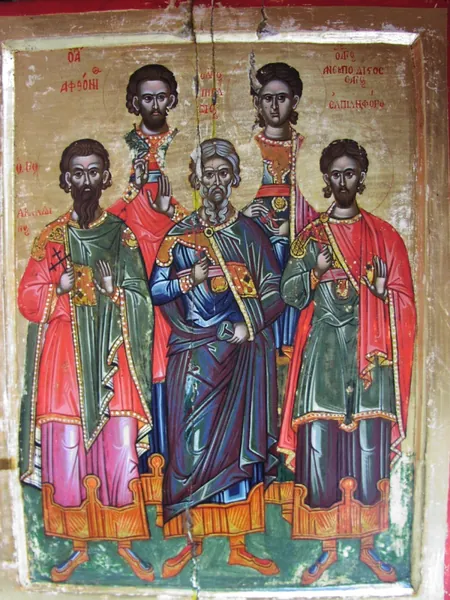
Holy Martyrs Acindynus, Pegasius, Aphthonius, Elpidephorus, Anempodistus and Those with Them (+c. 341–345)
The holy Martyrs Acindynus, Pegasius, Anempodistus, Aphthonius, Elpidephorus and others suffered for confessing the true faith in the reign of Shapur II, around 341–345. At that time Christianity had already spread widely in Persia. The Persians themselves followed Zoroastrianism: they worshipped the sun. All other religions were forbidden, but King Shapur, who wished to keep peaceful relations with the Emperor Constantine the Great (306–337), did not persecute the Christians at the beginning of his reign. Nevertheless the Persian priests, full of hatred for the Orthodox, could find no rest and waited for a suitable opportunity to destroy them. Such an opportunity came: Constantine the Great died, and Shapur began a war with his heir Constantius (337–361). The king of Persia began to be assured insistently that his Christian subjects were in constant touch with the enemy who shared their faith and were supplying them with everything needed for success in the war. The king began a cruel persecution of the Christians. So many Christians turned up in the country that the Persians could not hide their astonishment: even the king’s palace was full of Christians. Among others, envious men denounced to the king his faithful courtiers Acindynus, Pegasius and Anempodistus. The enraged autocrat ordered the saints to be tortured. The exhausted executioners relieved one another twice, but not a groan escaped the Lord’s chosen ones. Shapur himself could not bear the strain and lost consciousness. When he came to, the tormentor accused Acindynus, Pegasius and Anempodistus of sorcery and ordered them to be hung over a fire and suffocated with smoke. At the saints’ prayer the fire went out, and the bonds with which they were tied fell apart. When the king asked how this had happened, the martyrs preached to him Christ, who works many such wonders. The furious Shapur began to blaspheme the name of the Lord. Then the martyrs cried out: “Let thy mouth be shut!” and the king was struck dumb. Beside himself with fear and rage, Shapur tried to sign to his attendants to take the prisoners to prison, but those around him could not understand him. The king, now possessed, tore his mantle in fury and began to howl like a beast. Acindynus healed the king by the power of prayer, but this time too everything was put down to the saints’ sorcery, and their torture continued. The martyrs were laid on an iron grate and a fire was lit under them. The Lord’s chosen ones began to pray. Suddenly rain began to fall and the fire went out. Many who saw the miracles worked through the martyrs’ prayers believed in Christ.
One of the executioners, Aphthonius, publicly asked the holy martyrs’ forgiveness for the suffering he had caused them, and gave himself up to death for the name of Christ. The nobleman Elpidephorus and the king’s mother also confessed the true God. Shapur ordered that Acindynus, Pegasius and Anempodistus, and with them Elpidephorus, be punished by beheading. When the martyrs were led to the city wall to be killed, a countless crowd of people accompanied them. By the king’s order the soldiers slaughtered them all, about seven thousand. Elpidephorus too was killed with the others.
The next day Acindynus, Pegasius and Anempodistus, together with the king’s mother, were burned in the fire. Christians who came by night to the place where the saints had been executed found the bodies of the Lord’s chosen ones completely unharmed and committed them to the earth with honour.



