
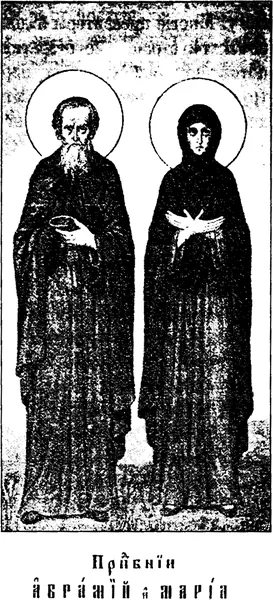
Venerable Abraham the Recluse and Blessed Mary, His Niece (+c. 360)
The Venerable Abraham the Recluse, a Syrian ascetic, lived in the fourth century. The saint was the son of a wealthy family, but he shut himself up in a lonely hut and spent his days in strict fasting and prayer. When his parents died, the Lord’s chosen one gave away all the property that came to him to the poor.
Some time later, at the request of the bishop and clergy of Edessa, he accepted the rank of presbyter and began to labour in a pagan village. For three years the holy father laboured tirelessly to enlighten the idol-worshippers, patiently enduring every kind of abuse and beating from them: once the godless left the ascetic, beaten half to death, abandoned in a nearby forest, but by the mercy of God he survived. The all-good Lord looked with mercy on His faithful servant, and his labour was crowned with success: the pagans believed in Christ and were baptised by the hand of the blessed Abraham. After this the venerable father returned to his old place of labour. The saint’s self-denial was boundless: all his property consisted of the tunic and sackcloth he wore, the bowl from which he took his food, and the mat on which he slept. The saint rose ever higher on the steps of spiritual perfection. The evil one, put to shame by his valour, tried to overcome the soul of the man well-pleasing to God with the passion of pride. Once, at midnight, while the Venerable Abraham was praying in his cell, the place suddenly shone with light and a voice was heard: “Blessed art thou, blessed as no other among men.” The saint understood the enemy’s wile and said: “I am a sinful man, but I hope in the help and grace of my Lord, and I do not fear thee.”
Many people went to the saint for spiritual counsel. For his unwearying labours the Lord granted him the gift of healing and of casting out evil spirits. Fifteen years before his death the Venerable Abraham, already an old man, came out of his seclusion a second time, this time for a short while, to save his niece Mary, who had strayed from the right way. After more than half a century of ascetic life the Lord’s chosen one, having reached seventy, reposed in peace around the year 360. A great crowd gathered for his burial. “Each one pressed eagerly towards his holy body, and they tore away the fringe of his garment, and as many of the sick as touched that fringe were healed.”
Information about the life of Saint Abraham the Recluse was preserved for us by his contemporary and spiritual friend, the Venerable Ephrem the Syrian (commemorated 28 January).
The Venerable Mary, niece of Abraham the Recluse, was seven years old when her parents died, and she was given to her uncle to be brought up. The holy father “commanded that she should dwell in the outer house”. Through the small window of his cell the Venerable Abraham taught Mary “the Psalter and other books”. The pure girl fasted, kept vigil and sang together with her uncle, “and strove to accomplish all the virtues”. Abraham shared out his niece’s whole property among orphans and the poor, and besought the Lord with tears “that her mind might not be bound by any earthly business or care”. “The devil raged against her.” A young man inflamed with love for the blessed girl managed to seduce the holy virgin: Mary opened the window, left her room “and was defiled with him in that pit of lawlessness”. After committing the sin the girl came to her senses and was overcome by despair; she did not dare return home, went off to another city and gave herself to a dissolute life. When he learned of his niece’s loss, Abraham wept bitterly and earnestly besought the Lord to guard her “from the mouth of the dragon”. Two years later the holy father learned where Mary was; he came out of his hut, put on the clothes of a layman and went to the city. Entering the brothel, the saint asked for Mary, “a comely woman”: “Call her to me, that I may make merry with her today, for I have fallen in love with her from the great report of her.” After he had said these words “his face was filled with tears”, but he restrained himself, “lest she should know him and flee”. Then the blessed father, “who in the fifty years of his monastic life had not tasted bread, nor wine at all, ate meat and drank wine, that he might save a soul that was lost”. After the feasting at table, when Mary had locked the door of the room, the Venerable Abraham, sitting on the bed, called her to him and gripped her hand tightly so that she could not run away; then he took off his cap, made himself known to his spiritual child and said with lamentation: “My child Mary, dost thou not know me? I am thy father’s brother Abraham! My child and my very heart, dost thou not know me? I am he who brought thee up! What is this thou hast done, my child, or who hath slain thee? Where is that angelic image of thine that thou didst wear? Why didst thou not tell me when thou didst sin, my child, and I would have besought God for thee together with our beloved Ephrem? Why hast thou done this deed? Why hast thou forsaken me thus and cast me into great sorrow, my child?” Then he reminded the fallen one of the torments of hell prepared for unrepentant sinners, and of God’s boundless mercy towards the penitent. When Mary heard this, “she became like a lifeless stone in his hands for fear and shame”. Abraham went on: “Dost thou answer me nothing, my child Mary, and say nothing to me, my heart? Upon me be that sin of thine, my child; I will give answer to God for it in the day of judgement; I will do penance for that sin of thine, my child”; and until midnight he besought and admonished her with weeping. At last Mary said: “If thou knowest that I am able to repent, and that God will accept my repentance and forgive me my sins, behold, I come; I fall down and entreat thy holiness and kiss thy feet, for thou hast shown me such mercy and come hither to bring me out of this pit of uncleanness.” She laid her head at the saint’s feet and wept all night, full of repentance and boundless gratitude to God. When day broke, uncle and niece returned to the place of seclusion. Abraham brought Saint Mary into the inner cell, where he himself had formerly laboured, and settled in the outer cell himself. “From then on that blessed woman repented in sackcloth and ashes, with sighing and bitter tears; with rising early and great vigil, with fasting and tears, with humility and meekness she strove earnestly, and repented diligently, and gave thanks unceasingly.” For her fervent labours the Lord granted His chosen one the forgiveness of her sins and the gift of healing.
After the blessed Abraham’s death the Venerable Mary lived five years, and “strove beyond measure and besought God with tears day and night”. When the Lord received the holy mother’s soul too, “her face shone like the sun”.



