
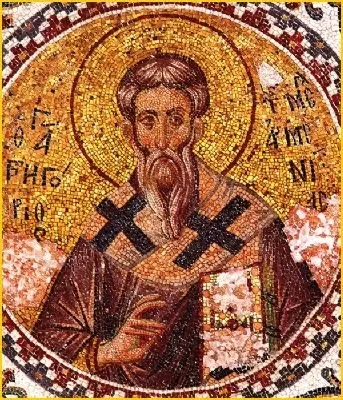
Hieromartyr Gregory the Bishop, Enlightener of Armenia (+c. 335); Holy Martyrs Rhipsime and Gaiane and the 35 Holy Virgins with Them (IV)
The Hieromartyr Gregory the Bishop, enlightener of Armenia, was born in 257. He was descended from the Arsacids, the royal house of the Parthians. The saint’s father, Anak, in a struggle for the throne of Armenia, took the life of his kinsman, King Kusar. For this his whole family was wiped out. Only Anak’s two infant sons survived, “who were still at the breast in their swaddling clothes”. One of them was taken for refuge to Persia, while the other, Gregory, was taken by a kinsman to Caesarea in Cappadocia and brought up in faithfulness to the commandments of Christ. When he came of age Gregory married and had two sons, but was soon widowed. The saint brought up his sons in piety. One of them, Orthanes, afterwards became a priest, while the other, Arostakes, was tonsured a monk and went out into the desert to labour. To atone for his father’s sin, Gregory joined the retinue of Kusar’s son Trdat and served the prince faithfully. Trdat loved Gregory as a friend, but could not endure his faith. After ascending the throne of Armenia he demanded that the blessed one deny Christ. Gregory answered with a firm refusal. Angered by this, the tormentor had his faithful servant terribly tortured: a stone was tied to his neck, he was hung upside down, nails were driven into his feet and he was made to run, he was beaten mercilessly, and a leather sack full of live coals was pulled down over his head… With God’s help Gregory patiently bore these and other torments. Trdat, still more enraged by the saint’s boldness, made the torture harsher and threw the martyr, his flesh torn and covered in blood, into prison. Here God healed His chosen one of his wounds, but the lawless autocrat did not grasp the miracle and handed him over for torture again. The martyr remained unbending, and “laughed at those torments and at his tormentors”.
Molten lead was poured into Gregory’s mouth, but, protected by the grace of the Holy Spirit, he took it like cool water and went on preaching the word of God. The astonished King Trdat decided to pardon Saint Gregory, but one courtier, losing patience, cried out aloud: “He is not worthy of life, nor even of the sight of this sun at all,” for he is the son of the Parthian Anak, your father’s murderer and the ravager of Armenia. These words filled the king with thirst for revenge, and he ordered Gregory, bound hand and foot, to be thrown into a dark pit at Ararat full of venomous reptiles and worms. The Lord protected the blessed one: the creeping things did him no harm, a devout woman brought him bread, and a holy angel revived and strengthened him. So fourteen years went by. During this time Trdat committed yet another lawless deed: he tortured to death Saint Rhipsime, Gaiane and thirty-five virgins with them.
The wrath of God did not pass by the lawless Trdat and the courtiers who had killed the handmaids of Christ: seized by the evil one, they roamed the forests, tearing their clothes and rending their own bodies. When Armenia “was bitterly wasting away with such suffering”, Trdat’s sister Kusarodukht was told in a vision in her sleep that if Gregory, thrown “long ago” into the pit at Ararat, were brought up, their trial would be lifted. The vision was repeated several times. Then one of the king’s nobles, named Autaias, went to the mouth of the pit and called the saint by name. Gregory answered from the depths of the pit. The courtier let down a rope to the blessed one and called down to him: “God has commanded that thou be brought up from there.”
The miraculously saved martyr’s body had become covered with hair, withered and blackened, but his firmness of spirit had not been shaken. He was washed, clothed in splendid garments and escorted with honour to the city of Valeroshen, “for their king Trdat was there”.
Gregory first of all sought out the incorrupt relics of the holy virgin martyrs, gathered them and buried them with honour. Then he built a church over the martyrs’ tomb. The blessed one brought the king, possessed by demons but already fallen into repentance, into this church and told him to pray to the virgin martyrs. The Lord accepted Trdat’s repentance, Gregory’s prayer and the intercession of the holy martyrs, and healed the king. His other courtiers were healed too. After this the saint built many more churches. In 301 the church of Pentecost at Etchmiadzin was built; in 305 the blessed Gregory went to Caesarea in Cappadocia, where Archbishop Leontius consecrated him bishop of Armenia. On his return the hierarch baptised first Trdat and his household, and then the whole Armenian nation, in the river Euphrates. For his apostolic work the saint was called the Enlightener of Armenia. He also converted to Christianity many inhabitants of the neighbouring lands of Persia and Syria. After setting the Armenian Church in order, Gregory went out into the desert “with a few of his disciples”, shut himself in a cleft of the rock and spent his days in prayer. He took bread only once in forty days. Trdat had Gregory’s son, the hermit Arostakes, sought out and brought to Armenia, and besought Gregory to hand over to him the throne of the head of the Church. And he, “when he saw every virtue planted in his son’s soul, at once laid his hands on the saint and consecrated him bishop”. The hierarch Arostakes took part in 325 in the First Ecumenical Council of Nicaea, which condemned the heresy of Arius. Saint Gregory the Parthian committed his soul to the Lord in his labours as a hermit in 335. His incorrupt right hand and some other holy relics are kept in Armenia, in the cathedral of Etchmiadzin.



