
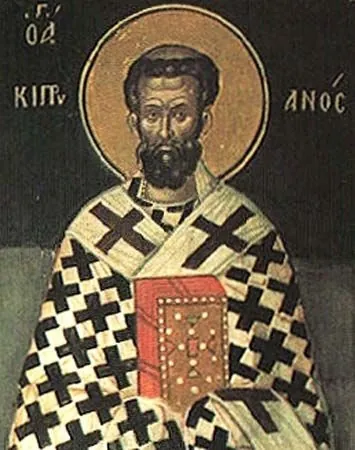
Hieromartyr Cyprian, Bishop of Carthage (+258)
The Hieromartyr Cyprian of Carthage was born around 200 in the city of Carthage (North Africa). The son of a rich pagan senator, he received an excellent secular education and while still young became a brilliant orator and a teacher of eloquence and philosophy. He spent his wealth on lavish feasts and a life of luxury, but even then he kept to stricter moral principles than the other pagans and longed for something better, something unknown. The Lord enlightened his mind: he sincerely believed in Christ and was baptised. Before his baptism the saint distributed all his property to the poor, and himself went to live with the presbyter Caecilius. About a year later he was ordained priest, and after the death of Donatus, Bishop of Carthage, in 248 he was unanimously chosen hierarch.
The blessed father zealously set about ordering the Church and fighting the vices that existed among the clergy and the faithful. At this time, in the reign of the God-loving Emperor Philip, the Christians lived fairly peacefully, but a great evil too had crept in among the Orthodox of Africa: amid the peace and security their hearts had gradually grown cold towards the faith; their former divine zeal had been replaced by a love of earthly pleasures, wealth and luxury; the brotherly love among fellow believers had faded, and no one remembered the poor any more. Cyprian tried by word and personal example to rouse the Christians and to show them the true aim of life.
Meanwhile the God-hating Decius (249–251) ascended the throne, of whom the saint had learned beforehand in a dream. A cruel persecution of the Christians began.
At the insistent request of the faithful Bishop Cyprian went into hiding, so as to help the persecuted by preserving his own life. But in Carthage dreadful things took place: it became plain how dangerous attachment to earthly well-being is, and how it cools the love of God. Lukewarm Christians began to perform the pagan sacrifices without any compulsion at all. Some did not offer sacrifice to the idols, but bought certificates saying that they had carried out this rite, and in this way kept their lives and property. The apostates were so numerous that the judges could not keep up with receiving their declarations of denial and put them off till the next day. In his letters Saint Cyprian urged the Christians to turn to prayer as their only sure weapon; he asked the presbyters to care for the weak and infirm and to labour for the restoration of the fallen; he ordered all his property to be distributed to poor believers, so that they would not side with the pagans out of poverty. He asked that the days of the martyrs’ deaths be recorded, so that afterwards their memory might be kept every year on those days. The holy father rejoiced over those who had not been afraid to confess Christ before the tormentors, but he feared that this labour might lead the confessors into pride, and he warned them in a fatherly way: “Let them be humble and meek and give others a good example by their later conduct too. The most severe trial is still to come. The Lord said: ‘He that shall endure unto the end, the same shall be saved’ (Matt. 24:13). Let them imitate Jesus Christ, who just before His Passion showed us the greatest example of humility by washing His disciples’ feet… Now more than ever they must fear falling into the snare of the enemy, who, moved by the desire to avenge the defeat he has suffered, attacks the strongest with special zeal.”
Cyprian’s fear proved justified: the Church of Carthage was troubled not so much by the faint-heartedness of the apostates as by the unseemly pride and blameworthy conduct of some of the confessors. Some of them, proud of the labour they had accomplished, broke the rules of the Church and in their own name gave written permits to apostates who wished to return to the community; whereas in the Church there had been a rule from of old that grave sinners were to be received back only after full repentance. The period of probation was from one to three years, according to the gravity of the sin. The breaking of the rules troubled the Churches of Rome and Carthage and gave rise to a schism. The Roman presbyter Novatian began to assert that it was utterly inadmissible to receive those who had fallen away from God into the Lord’s Church, and that no repentance could wipe out their sin. He found many followers. In his epistles Saint Cyprian condemned the heresy of the Novatians and advised a middle way in dealing with the apostates: to refrain both from a frivolous leniency that demanded no repentance from those who had sinned, and from an excessive severity that did not agree with the spirit of the Gospel teaching.
Two years later, when Decius died, Cyprian returned to Carthage. To settle the disputed questions that had arisen among the faithful during his absence, the blessed hierarch convened a local council, which tried to bring peace to the troubled Church and establish unity.
Some time later Gallus (251–253) ascended the throne and renewed the persecution of the Christians. This time Cyprian decided to remain in his diocese and to prepare his flock to fulfil their Christian duties.
Contrary to expectation, the Christians living in the region of Africa this time hardly experienced persecution at all, but another calamity fell upon them: an epidemic of plague. Every day thousands of people died. Here the strength of the Orthodox faith was plainly shown. Inspired by the grace-filled words and personal example of the hierarch Cyprian, the Christians spared neither life nor property to pay due honour to the dead and to help the doomed; some of them took the sick into their own homes. At this time the holy father wrote the book On Mortality, in which he speaks of the vanity and transience of this world and tries to turn the Christians’ minds towards the future, eternal life.
The plague had only just ended when barbarians broke into the region of Numidia, which bordered on Carthage, and carried off many Christians into captivity. Saint Cyprian said to his flock: “Not only feeling but the law too obliges us to ransom our captive brethren: Christ dwells in them.” The Orthodox of Carthage did indeed take the plight of the Numidians very much to heart and gave generous offerings for their ransom.
In 253 the Emperor Valerian (253–260) ascended the throne. During the first six peaceful years of his reign Cyprian diligently cared for the ordering of the affairs of the Church. The Emperor Valerian’s goodwill towards the Christians was turned to hatred at the instigation of his favourite courtier, Valerian Macrianus, and this is what caused the renewal of the persecution of those who hoped in the Saviour. Paternus, the proconsul of Carthage, demanded that the hierarch Cyprian offer sacrifice to the idols. The saint refused both to carry out this demand and to reveal the names and whereabouts of the clergy of Carthage. For this the blessed father was exiled to the seaside town of Curubis. The deacon Pontius went with him of his own accord. On the day the holy bishop arrived at the place of exile, the Lord revealed to him in a dream that exactly one year later he would die a martyr. During his exile the saint wrote many epistles and books.
Around 258 the blessed father was recalled from Curubis and brought before the tribunal. Because the proconsul was ill, the session was put off for a day. The saint spent that night in the house of a pagan official. His whereabouts became known in the city, and a great multitude of people gathered near this house. In the morning, when the hierarch was led to the court building, the assembled Christians followed him. The judge demanded that the blessed one offer sacrifice to the idols and, when he received a firm refusal in reply, sentenced him to be beheaded with the sword. When he heard the sentence, the lamb of Christ cried out: “Glory to the Lord!” And the people shouted: “We too wish to die with him!” When they reached the place of execution, Cyprian blessed everyone and gave orders for twenty-five gold coins to be given to the executioner in his name. Then he bound his eyes with his own hands, had the presbyter and subdeacon standing by tie his hands, and bowed his neck to the sword. The blessed father died a martyr in 258. His holy body was carried away at night and buried with honour in the private burial ground of the procurator Macrobius Candidianus.
Later, in the time of Charlemagne (771–814), the hieromartyr’s incorrupt relics were translated with honour to France.
Saint Cyprian of Carthage left us a precious legacy: God-inspired writings and eighty epistles. They were accepted as models of the Orthodox faith and were read at the Ecumenical Councils (the Third, of Ephesus, and the Fourth, of Chalcedon).



