
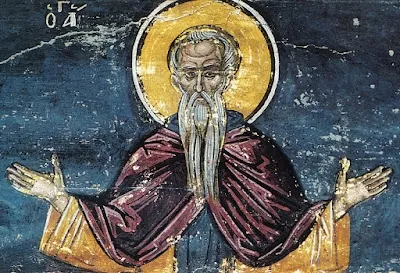
Venerable Poemen the Great (+c. 450)
The Venerable Poemen the Great was born in Egypt around 340. Seeking the angelic life, he left the world together with his brothers Anoub (commemorated 5 June) and Paisius, went to one of the monasteries of Egypt and became a monk. Once their mother came to see the ascetics, but they did not come out of their cells. The woman stood weeping for a long time. At last Poemen called to her through the closed door: “If thou endurest being parted from us for a time, thou shalt see us again in the life to come; we hope in the love of God for mankind!” At these words the mother was calmed and went home comforted. Once, when the report of the Venerable Poemen’s labours and virtues had spread through the whole country, the governor of the region wished to visit him. The elder thought that if the nobles began to come to him, the whole people would follow their example, which would hinder his silence and perhaps even lead him into pride, and he sent the messengers away with a refusal. The governor was grieved; but he wished so strongly to see the great ascetic that he promised the parents of the saint’s nephew, who was in prison, that he would free him in exchange for Saint Poemen’s meeting him; otherwise the governor threatened to put the prisoner to death. Beside herself with grief, his sister came running to the saint to ask for help. He did not even open the door to her, and in answer to her reproaches said only: “Poemen has no children, and so his heart does not ache.” Driven to despair by the bitter answer, the mother went back weeping and cursing her brother; and the governor, having finally lost hope of seeing the venerable father, said: let him at least write me something. This request the desert-dweller did grant: he wrote: “If your lordship will be pleased to review the young man’s case and is convinced that he deserves death, let him die, so that by a temporal punishment he may escape eternal torments; but if his offence does not merit death, pass a fitting sentence and set him free.” Rejoicing at receiving the saint’s letter, the governor at once released the young man from prison.
The Venerable Poemen was a strict faster and for weeks, sometimes longer, took no food; but he advised others to eat every day, though not to satiety. To a monk who allowed himself to take food only every seventh day, but grew angry with the brethren, the saint said: “Thou hast learned to fast six days, but thou canst not refrain from anger for a single day.” When asked which is better, speaking or silence, the desert-dweller answered: “He who speaks for the glory of God does well, and he who keeps silence for God also does well.” “It happens,” said the blessed father, “that a man seems outwardly sparing of words, but if in his heart he judges others, then he is always talking. And there are those who talk with their tongue all day, but inwardly keep silence, because they judge no one.” When the monks asked: “When we see a brother dozing during the divine service, should we nudge him to wake him?” the blessed one answered: “In such a case I would lay his head on my knees, so that he might rest more sweetly.”
“A man needs three things: the fear of God, frequent prayer, and doing good to men,” said the Venerable Poemen. “Evil is not rooted out by evil. If anyone does thee evil, answer him with good, and thy good will overcome his malice.” The blessed father was in the habit of often changing his place of labour, thus avoiding the danger of human glory. Once he came with his disciples to the Egyptian desert and founded a monastery. At that time there lived here an elder whom everyone revered for his firm faith and piety and regarded as their intercessor. Believers came from other countries too to receive his prayers, blessing and counsel; but when Poemen appeared nearby, most of the people went to him. This angered the desert-dweller; he was filled with envy of the newcomer and saw only bad in everything he did. When Poemen learned of this, he was greatly grieved and said to his disciples: “Brethren! What shall we do with these frivolous people, who have left such a holy ascetic and come to us, who are good for nothing? How shall we heal the great father’s anger?! Let us go and entreat him; perhaps we may soften his heart.” The saint with the brethren came to the elder’s cell to ask his blessing. The offended father refused to receive the visitors, but Poemen and his brethren stood without moving in the terrible heat until their host, moved by their humility and obedience, was completely freed from his resentment and opened the door to them with love. After talking with his visitors the elder said: “Truly, what I have heard of you is true; more than that, I see a hundred times more good in you!”
Once a monk came to the holy desert-dweller from a distant land to receive spiritual profit. The blessed one received the newcomer kindly, but when he began to talk of lofty and hard-to-grasp things, he lowered his eyes and left all his questions unanswered. The guest took leave of the saint and, coming out of the cell, complained to Poemen’s disciple: “I have toiled in vain! I wanted to learn something, but did not hear a single word!” When this was reported to the venerable father, he said: “He was talking about things beyond the reach of the human mind. What could I teach about them? Had he spoken of human weaknesses, I would gladly have answered him.” Then the proud monk went back into the cell and, ashamed, began: “Father, what shall I do? The passions have taken me completely captive!” Poemen met him with a kind and cheerful look: “Now thou hast come on a good and profitable matter!” Then he talked with the visitor for a long time, until evening, and he returned to his desert rejoicing in spirit.
The Venerable Poemen reposed in 450, at the age of a hundred and ten.



