
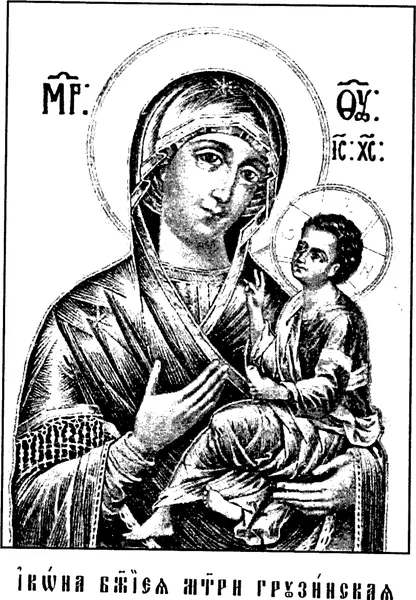
Feast of the Icon of the Mother of God Called the Iverian (Georgian), in Moscow, in the Monastery of Metropolitan Alexis (1650)
The icon of the Mother of God called the Iverian (Georgian). In 1622 Shah Abbas conquered and sacked Georgia and carried many holy things off to Persia. Among them was the icon of the Mother of God painted in Georgia and called the Iverian (Georgian), which Stephen, one of the servants of George Lytkin, a merchant of Yaroslavl, bought and presented to his master. George Lytkin, prompted by God, gave the holy thing to the Chernogorsky (later Krasnogorsky) monastery for men in the diocese of Arkhangelsk, in the region of the Dvina. A great many miracles came from this holy icon, and in 1650 its feast was instituted.
In 1654 the icon of the Mother of God called the Iverian (Georgian) was brought to Moscow to be restored and to have its cover adorned, and was placed in the church of the Most Holy Trinity in Kitai-Gorod. At this time an exact copy was made of the icon and placed in the same church. Moscow was then ravaged by an epidemic of plague. A great many afflicted people thronged to the church, and the newly made icon too shone forth with miracles. In 1658, by order of the tsar and with the blessing of Patriarch Nikon, it was decided to establish the feast of this icon on 22 August. In 1904, in connection with the 250th anniversary of the manifestation of the Georgian icon of the Mother of God, a church in honour of this icon was set up in the lower part of the church of the Most Holy Trinity, and the holy icon was placed in its iconostasis.



