
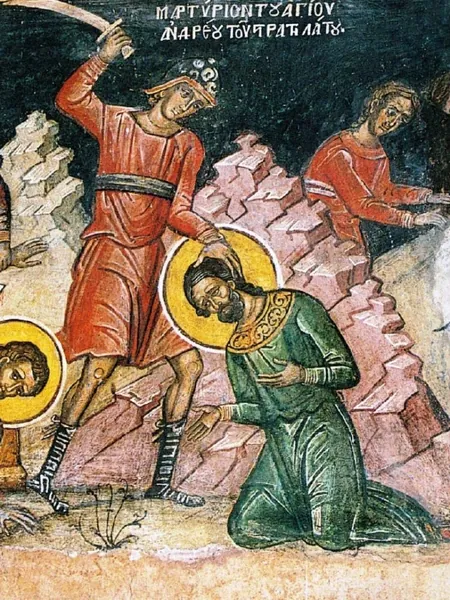
Holy Martyr Andrew Stratelates and the Two Thousand Five Hundred and Ninety-three Martyrs with Him (+c. 302)
The holy Martyr Andrew Stratelates served in the Roman army in the reign of the Emperor Maximian (284–305; 307–310). He had not yet received baptism, but hoped firmly in Jesus Christ. For his courage, prowess and justice Andrew was greatly loved by all. When a countless Persian army crossed the borders of Syria, the governor Antiochus entrusted him with leading the battle against the invaders. Before the battle the saint addressed his small force thus: the pagan gods are demons, and it is vain to expect help from them; and he preached Christ to them, the almighty King of heaven and earth. Their spiritual eyes opened by the commander’s words, the warriors called on the name of the Saviour and so attacked the enemy. As a result the small detachment inflicted a shameful defeat on the countless Persian host and drove it out of the country. This campaign clothed Saint Andrew’s name with radiant glory. The envious reported to the governor that he was a Christian and had converted his detachment to Christianity. The saint was summoned before the tribunal and handed over to torture. After the torture the governor Antiochus threw the saint into prison together with the other soldiers and informed Diocletian of what had happened; he himself did not dare to put the famous hero to death. The lawless autocrat knew how much the army loved Saint Andrew; he feared a rebellion, and ordered the martyrs to be released and then killed one by one on various pretexts.
Coming out of prison, the confessors went to the city of Tarsus and were baptised there by the hand of the local hierarch, Peter, and of Nonnus, Bishop of Beroea. Afterwards the lambs of Christ moved to a place called Taxanata. Antiochus told Seleucus, the governor of the region of Cilicia, to overtake the soldiers and slaughter them all, supposedly for deserting their standards. Saint Andrew with his detachment awaited the pursuers encamped in the mountains of Armenia, at Taurus: according to a revelation it was here that they were to die as martyrs. Andrew urged his soldiers not to fear death; he prayed for all who would honour their memory and asked the Lord to bring forth a healing spring on the spot where their blood would be shed. During this prayer the martyrs, who offered no resistance to their attackers, were hacked down with swords (+c. 302). At that very moment a healing spring gushed from the earth. The bishops Peter and Nonnus with clergy were secretly following the track of the blessed Andrew’s detachment. The Lord granted to them the burial of the martyrs’ holy bodies.



