
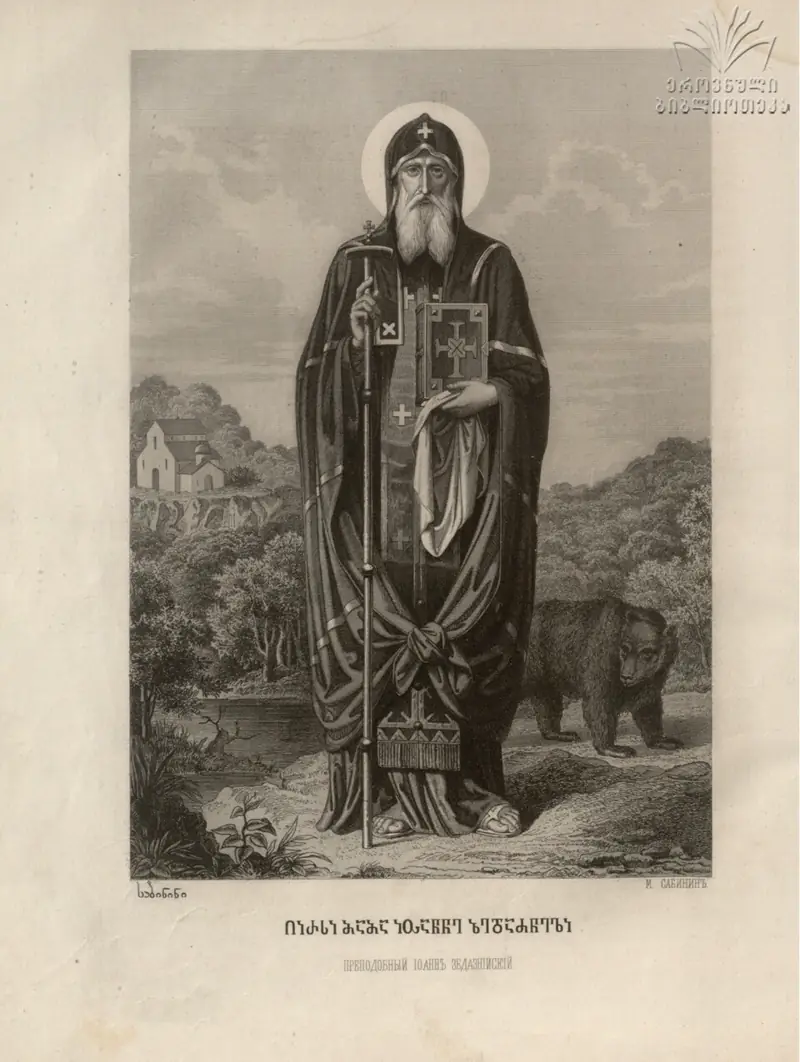
Venerable John of Zedazeni and His Twelve Disciples: Abibos of Nekresi, Anthony of Martqopi, David of Gareji, Zenon of Iqalto, Thaddeus of Stepantsminda, Ise of Tsilkani, Joseph of Alaverdi, Isidore of Samtavisi, Michael of Ulumbo, Pyrrhus of Breti, Stephen of Khirsa and Shio of Mgvime (VI)
The Venerable John of Zedazeni and his twelve disciples, Abibos of Nekresi, Anthony of Martqopi, David of Gareji, Zenon of Iqalto, Thaddeus of Stepantsminda, Ise of Tsilkani, Joseph of Alaverdi, Isidore of Samtavisi, Michael of Ulumbo, Pyrrhus of Breti, Stephen of Khirsa and Shio of Mgvime, were Syrian ascetics who revived and established the monastic life in Georgia.
The Venerable John of Zedazeni received his spiritual education in Antioch. While still very young he left the tempting world, became a monk, and went into the desert to labour. His humility, fasting and vigil, his tears and supplication pleased the Lord, and He granted His faithful servant the gift of healing illnesses and casting out demons. The Venerable John became famous for his holy life and his miracles. A great many people came to see him, and so the holy father thought it necessary to leave that place; he took some of his disciples, chose a remote spot, built cells and began to labour.
Once the Most Holy Mother of God appeared to the Venerable John and commanded him to choose twelve monks from among his disciples and go with them to Georgia to strengthen the law of Christ. Saint John made known the command of the Mother of God to his disciples. After long fasting and prayer, at God’s indication, he chose twelve of his disciples: Shio, David, Anthony, Ise, Joseph, Thaddeus, Stephen, Isidore, Michael, Pyrrhus, Zenon and Abibos. He left the monk Euthymius in his place as teacher for those who remained in the desert, and himself came to Georgia with the brethren.
The king of Georgia and the Catholicos were told by an angel of the coming to Georgia of the holy fathers who had shone forth in Mesopotamia. As the fathers drew near to Mtskheta, King Parsman and Catholicos Evlavios with the clergy came out to meet them.
With the blessing of Catholicos Evlavios Saint John settled with his disciples on Mount Zedazeni, where the idol of Zaden had once stood. The ascetics lived in poor cells and ate only plants.
The people heard of Saint John’s miracles. In many a sincere desire for the monastic life was awakened; many left the vain, troubled life of the world and settled on Zedazeni to labour. Thus Mount Zedazeni became a dwelling place of hermits.
One night the Most Holy Mother of God appeared to Saint John and commanded him to send his disciples to various regions to preach. The next day he gathered them, told them what he had seen, and said to them: “For the good of this land hath the Lord our God Jesus Christ sent us forth, for the men of this land are a new planting; therefore it is fitting that ye go forth, each one of you, and strengthen the brethren who have confessed Christ our Lord.”
After sending out his disciples Saint John remained on Zedazeni, kept with him Elias the deacon (commemorated 4 January), and took up his accustomed labours. Teacher and disciple endured many obstacles and trials. Zedazeni was a waterless place. Every day Elias the deacon carried water from a great distance. Seeing his disciple’s hard labour, Saint John asked the Lord to bring forth a spring. The good Lord heard the holy elder’s prayer, and a healing spring came forth on the summit of the mountain.
A bear became accustomed to the spring that had come forth through Saint John’s prayer. Through Saint John’s prayer the beast was tamed. After this the wild animals living in the forest of Zedazeni did no harm to anyone. Through the prayer of the Venerable John a man long crippled and a man struck dumb were healed. Saint John would summon his disciples to him, or sometimes visit them himself, and examine what measure of spiritual life they had attained.
After long labours the approach of his end was revealed to Saint John by the Lord. The venerable father called his disciples, instructed them, blessed them, and left them his testament that they should bury him in the cave where he had laboured.
Grieving at their teacher’s departure, the disciples carried him to the monastery at the foot of Zedazeni. Suddenly the earth shook, and it did not calm down until they remembered the holy father’s testament and understood that this earthquake was a heavenly sign. The disciples of Saint John, accompanied by priests and deacons, went to their teacher’s grave, uncovered the holy relics with honour, and buried them as he had instructed. At the uncovering of the holy relics many sick and possessed people were healed.
In the tenth century, in the time of Catholicos Clement (908–923), a church dedicated to Saint John the Baptist was built to the south of the cave. The grave of Saint John of Zedazeni is by the prothesis of the church.
The holy Hieromartyr Abibos, at the request of King Parsman VI and Catholicos Evlavios, was appointed Bishop of Nekresi. At that time the Persian magi were freely spreading their false teaching in eastern Georgia and by force turning many away from the truth. Once, to expose the cunning of the fire-worshippers, the holy hierarch Abibos poured water on the fire burning on their altar and put it out. The enraged Persians seized Saint Abibos, beat him cruelly, and then stoned him. By order of the marzban the saint’s body was thrown out under the open sky to be torn by beasts, but neither beast nor bird touched the holy martyr’s body.
At night Christians living in Rekha came and buried the holy hierarch’s body with great honour in the monastery of Samtavisi. Later Stephanoz, eristavi of Kartli, translated Saint Abibos’s incorrupt relics from Samtavisi to the Samtavro monastery in Mtskheta and buried them under the holy altar.
Saint Anthony of Martqopi always carried with him the Image of the Saviour Not Made by Hands, which he had brought from Edessa. By his grace-filled prayer and his miracles the solitude-loving holy father drew many Christians. Saint Anthony built a monastery for his fellow ascetics, while he himself went first beyond the Alazani, and later took refuge on Mount Akriani. The Lord sent deer to feed the solitary monk, who ate grass and the bark of trees. Saint Anthony built a pillar on the summit of the mountain, shut himself up on it, and laboured there for eighteen years. The day of his departure from the body was revealed to the venerable father by the Lord beforehand. At the time of his death Father Anthony was kneeling in prayer before the icon of the Saviour. His disciples brought the Venerable Anthony’s body down from the pillar and buried it in the monastery he had founded, before the icon of the Mother of God.
Saint David of Gareji settled to labour in Tbilisi, the new capital of Georgia. Secluded on a mountain rising on the edge of the city, the monk drew many people by his wonderful preaching and holy life, and converted many fire-worshippers. The enraged magi bribed a pregnant harlot and accused Father David of fornication with her. The saint touched the woman’s belly with his staff and said: “Thee, child, I command in the name of our Lord Jesus Christ to tell us whether or not I am thy father.” The child answered the saint from its mother’s womb and pointed to another man. The enraged people stoned the woman. Horrified, David, who had been unable to restrain the furious crowd, spread his cloak on the river Mtkvari, stood on it with his disciple Saint Lucian, and, in spite of the fervent entreaties of the people of Tbilisi, left the city.
Father David and Lucian settled in the desert of Gareji. The Lord miraculously provided food for the ascetics. Every day except Wednesday and Friday deer came to them; Lucian milked them, Father David signed the milk with the cross, and it turned into cheese. The whole country heard of the miracles of the fathers of Gareji, and soon there “settled multitudes of men who found sweetness in the desert life”.
From Ninotsminda there came to the Venerable David the monk Dodo, adorned with virtues (commemorated on the Wednesday after the Ascension), who at his teacher’s command built a monastery dedicated to the Most Holy Mother of God on a spur of the rock.
Some time later the Venerable David went to Jerusalem on pilgrimage. Out of a sense of his unworthiness the monk would not enter the holy city; he prayed long and fervently at the gate, then took three stones from that place and brought them back to Georgia as holy things. That night an angel of the Lord appeared to Elias, Patriarch of Jerusalem, and told him that Father David, who had come from Georgia, was by his faith carrying away the whole grace of Jerusalem. Men sent by the patriarch took two of the stones from Father David, but the holy monk brought the third to Georgia.
After a long and God-pleasing life Father David reposed and was buried there, in the monastery of Gareji.
Saint Ise of Tsilkani, on Father John’s advice, was consecrated Bishop of Tsilkani by Catholicos Evlavios. The venerable father “converted a great many unbelievers by his teaching, and spread instruction and preaching among his flock”. Once the Venerable John decided to test his disciples in virtue and spiritual life. Saint Ise went down to the bank of the river Ksani, made the sign of the cross over the river, then touched it with his staff and said: “In the name of the Lord I command thee: flow along after me as I go, and follow me wherever I go.” A stream of water separated from the river and followed the Venerable Ise’s staff. The venerable father brought the water right up to the cathedral of Tsilkani. This miracle converted many people to the law of Christ.
Saint Ise learned from the Lord beforehand the day of his departure from the body; he received the Holy Mysteries and commended his soul to the Lord in prayer. The holy father was buried there, in the church of the Mother of God at Tsilkani.
Saint Joseph of Alaverdi always carried with him a cross made from the wood of the Life-giving Cross of the Saviour. With the blessing of Saint John of Zedazeni he preached in various places in Kakheti, and at last chose the desert of Alaverdi and began to labour there. Once, when he was quite alone, the monk met a nobleman out hunting, to whom he preached the word of God. Gladdened by Father Joseph’s grace-filled teaching, the nobleman laid the foundation of the monastery of Alaverdi. The people heard of the ascetic monk and began to come to see the wonderful father and hear his teaching. Many stayed there. In the course of time the number of desert-dwellers grew and formed a large community.
Weakened by long labour and toil, Abba Joseph appointed a superior for his disciples and reposed in God. He was buried in the church of Alaverdi, which he had built. Many miracles take place at Abba Joseph’s grave.
Saint Shio of Mgvime laboured in a cave among the rocks of Sarkineti. The Most Holy Mother of God herself blessed the monk labouring in the desolate place. Evagre, lord of Tsikhedidi (commemorated 4 February), who was hunting on the mountain of Sarkineti, saw this, visited the wonderful monk, and became his disciple. Soon the place was filled with desert fathers. Saint Shio founded a monastery at Sarkineti and gathered two thousand monks. Saint Shio vowed to spend the rest of his life in a cave. He dug a cave in his own monastery and went down into it. The Venerable Shio laboured in the cave for fifteen years.
Saint Isidore of Samtavisi, with his teacher’s blessing, preached in Kartli for a long time. Then, east of Rekhula, he founded the monastery of Samtavisi, dedicated to the Image of the Saviour Not Made by Hands; his disciples buried the venerable father in the monastery he had founded.
Saint Thaddeus of Stepantsminda laboured first in Mtskheta. He built a monastery at the foot of Zedazeni. The saint preached in Kartli, where he built many churches, among them the church of the holy Protomartyr Stephen in Urbnisi. Then he shut himself up in a cave on Mount Tlevi (near Kaspi). He died and is buried there.
Saint Stephen of Khirsa preached in Kakheti with his fellow ascetics. He is buried in the church dedicated to Saint Stephen the Protomartyr, by the prothesis.
Saint Zenon of Iqalto preached in the highlands of Kakheti, then founded a monastery at Iqalto and laboured there until his death. He is buried in the church dedicated to the Image of the Saviour Not Made by Hands.
Saint Pyrrhus of Breti, “a divine image of repentance”, founded a monastery at Breti, on the left bank of the river Jvaristsqali. His holy relics are buried in this monastery.
Saint Michael of Ulumbo preached in Upper Kartli and in Ossetia. Near Ulumbo he founded a great monastery. His wonderworking holy relics rest there.
In the lavras and monasteries founded by the holy Syrian fathers the children of the Georgians were trained in mind and morals; from these deserts grace and blessing poured out upon the Georgian people. These monasteries and the holy fathers who founded them became the protectors of the Georgians and their defenders against lawlessness and vice.



