
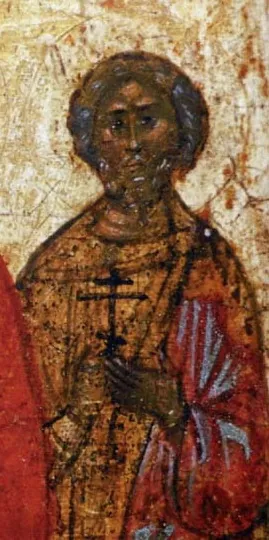
Holy Martyr Pontius of Rome (+c. 257); Hieromartyrs Anterus (+236) and Fabian (+250), Popes of Rome
The holy Martyr Pontius lived in the third century. He was the son of Mark, a pagan Roman senator, and his wife Julia. Once, when the pregnant Julia went with her husband into the temple of Jupiter, the demon dwelling there roared through the mouth of the priest: “The child this woman carries in her womb will destroy Jupiter and his altar!” When the child came into the world, his mother, frightened by the prophecy, wished to kill him, but her husband opposed her, and the child was saved. The boy was named Pontius. When he grew up, Saint Pontius became interested in the teaching of the Christians and went to Pontian, Pope of Rome, for counsel; his mind enlightened by the truth of the Christian faith, he confessed Christianity. Pontius converted his father to Christianity too, and Pontian baptised him with his whole household. After his father’s death the Emperor Alexander Severus (222–235) appointed Pontius, then twenty years old, a senator in his father’s place. In the senate and among the emperor’s circle Pontius enjoyed general respect. In the time of the Emperor Alexander’s successor, Maximinus (235–238), Pope Pontian ended his life as a martyr (+235).
After the holy pope the hierarch Anterus was chosen Bishop of Rome, and he soon shared his predecessor’s lot: he died a martyr for Christ (+236). Saint Fabian ascended the throne of the blessed hieromartyr. Pontius, whom the holy head of the Church loved like a son, gave him all his property for the needs of the poor. In 238 the lawless Maximinus died. The Emperor Gordian III (238–244) came to the throne and stopped the persecution of the Christians. His successor, the Emperor Philip (244–249), under the influence of Saint Pontius’s conversations and preaching believed in Christ and was baptised together with his son and co-ruler Philip by the hand of the holy Pope Fabian. With the emperor’s consent Saint Pontius and the hierarch Fabian smashed the idol of Jupiter in the pagan temple and raised an Orthodox church in its place. For four years peace reigned in the Church of Christ, and then the lawless Decius (249–251) ascended the throne; he organised a conspiracy and put the Emperor Philip and his son to death. At this time the hierarch Fabian suffered martyrdom (+250), while Saint Pontius left Rome, went to the city of Cimella on the border between Italy and Gaul, and lived there the life of a pilgrim. Meanwhile the Emperor Valerian (253–259) sent executioners to every corner of the country with orders to seek out and slaughter all the Christians. For this purpose Claudius and Anabius came to the city of Cimella. Saint Pontius fearlessly confessed Christ and refused to offer sacrifice to the idols. For this the blessed one was thrown into prison. When the tormentors made ready to torture Pontius, the saint calmly warned them that before the torture was over they would become witnesses of the Lord’s mighty power. And indeed, as soon as the servants tried to bind the blessed one to the rack, the instrument fell to pieces and the executioners dropped to the ground as if dead.
“Know, O thou of false belief, the almighty power of my Lord,” Saint Pontius said to Claudius; but he, on Anabius’s advice, threw the martyr to two bears in the circus to be torn apart. The beasts did not touch the saint, but tore the guards to pieces. “One is God, the God of the Christians, whom Pontius confesses!” the people shouted. By order of the tormentors the executioners lit a great pyre to burn the blessed one. The fire went out, and Pontius remained unharmed. The spectators cried out still more thunderously: “Great is the God of the Christians!” Then the indignant Jews who were there roared: “Kill this sorcerer quickly!” Pontius remembered how the crowd that wished Christ crucified had cried to Pontius Pilate: “Crucify him, crucify him,” and gave thanks to the Lord. They decided to behead the holy confessor. The sentence was carried out outside the city (+257). The saint’s remains were buried at the place of execution by his friend Valerian. Later the holy body was translated to the city of Nice, near Cimella.



