
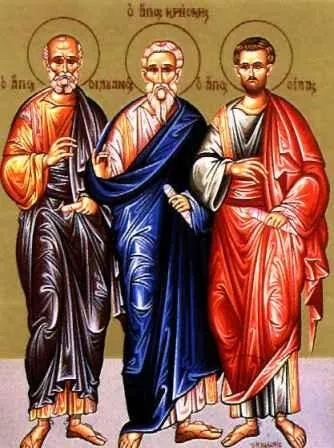
Holy Apostles of the Seventy Silas, Silvanus, Crescens, Epaenetus and Andronicus (I)
The holy Apostles of the Seventy Silas, Silvanus, Crescens, Epaenetus and Andronicus were disciples of the Saviour.
In the first Church of Jerusalem Saint Silas was a man held in honour, one of the “chief men among the brethren” (Acts 15:22). After the first Council of the Apostles held in Jerusalem in 51, the disciples of the Lord sent a letter to the Christians of Antioch by the hand of Paul and Barnabas, telling them that Christians converted from among the Gentiles were not obliged to be circumcised and to keep the Law of Moses; and they sent Silas and Judas with them, who, “being prophets also themselves, exhorted the brethren with many words, and confirmed them.” They stayed a long time in Antioch; then Judas was sent back by the brethren to Jerusalem, but “it pleased Silas to abide there still,” and he zealously helped the Apostle of the Gentiles in his labours of preaching. With Paul he travelled through Syria, Cilicia and Macedonia.
In the city of Philippi the apostles were seized, and “when they had laid many stripes upon them,” were shut up in prison. “At midnight,” as Paul and Silas were praying and singing praises to God, “suddenly there was a great earthquake, so that the foundations of the prison were shaken: and immediately all the doors were opened, and every one’s bands were loosed.” When the keeper of the prison awoke and saw the doors open, he thought the prisoners had fled, drew his sword and was about to kill himself, but the Apostle Paul “cried with a loud voice”: “Do thyself no harm: for we are all here.” Comforted, the keeper called for a light and, when he found all the prisoners in their places, “came trembling, and fell down before Paul and Silas.” He asked: “Sirs, what must I do to be saved?” He received the answer: “Believe on the Lord Jesus Christ, and thou shalt be saved, and thy house.” He received the grace-filled words with faith; that night he took the apostles into his house, “washed their stripes,” and was baptised with his whole household (Acts 15:20–16:34).
From Philippi Paul and Silas went to Amphipolis, passed through Apollonia and Thessalonica, converted many pagans, and strengthened the churches. In Corinth Silas was consecrated bishop. He governed his flock well, worked many miracles, and then commended his soul to the Lord in peace.
The holy Apostle Silvanus preached the word of God together with the chief apostles Peter and Paul. The Apostle Peter mentions him in his First Catholic Epistle: “By Silvanus, a faithful brother unto you, as I suppose, I have written briefly” (1 Pet. 5:12). Saint Silvanus was consecrated Bishop of Thessalonica, endured many afflictions and trials, and at last died a martyr.
The Apostle Paul mentions the holy Apostle Crescens in the Second Epistle to Timothy, where he notes that he had gone to Galatia to preach (2 Tim. 4:10). Here the saint was consecrated bishop; afterwards he spread the teaching of the Gospel in Gaul as well. In the city of Vienne he appointed his disciple Zacharias hierarch, and after returning to Galatia he died a martyr in the reign of the Emperor Trajan (98–117).
The holy Apostle Epaenetus was consecrated Bishop of Carthage. In the Epistle to the Romans the Apostle Paul writes: “Salute my wellbeloved Epaenetus, who is the firstfruits of Achaia unto Christ” (16:5). In the same epistle the chief apostle also mentions Saint Andronicus: “Salute Andronicus and Junia, my kinsmen, and my fellowprisoners, who are of note among the apostles, who also were in Christ before me” (16:7). The holy Apostle Andronicus was Bishop of Pannonia (Saints Andronicus and Junia are commemorated on 17 May).



