
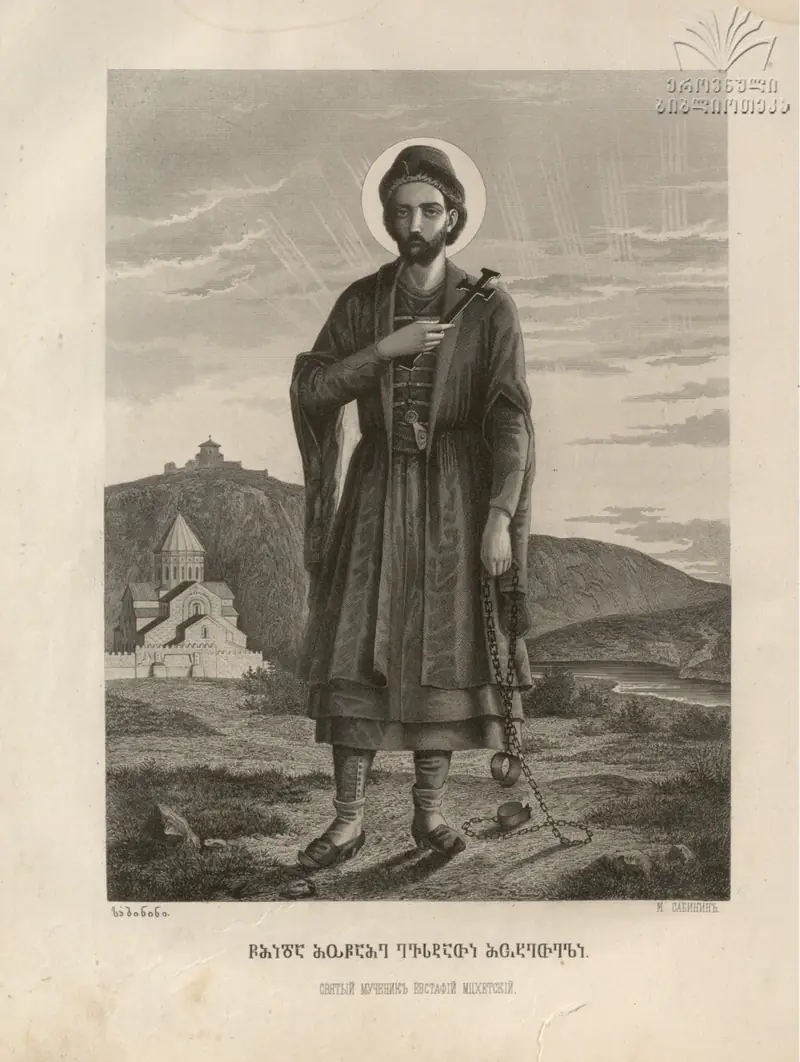
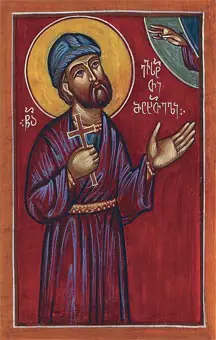
Holy Martyr Eustathius of Mtskheta (+551)
Saint Eustathius of Mtskheta was a Persian by origin. He came to Georgia and settled in Kartli. He liked the ways of the Georgians so much that he resolved to become a Christian, which at that time was very dangerous. Gvirobandak (so he was called before his baptism) received baptism at the hands of Catholicos Samuel and was given the Christian name Eustathius. Soon he married a Georgian woman and became wholly one with the nation that had become one with Christ.
Once the Persians of Mtskheta invited Eustathius to a festival, but the saint kept far from it: “I am sealed with the seal of Christ and have parted from that darkness of yours,” he sent word to his former countrymen. When the festival was over, the fire-worshippers denounced Eustathius to Ustam, the commander of the fortress of Mtskheta. He summoned the saint to him.
At first Eustathius hesitated, but then he thought: “These are my friends, and if I am afraid of them, how shall I behave before another? I will go and confess Christ openly, for it is written: ‘Whosoever shall confess me before men, him will I confess also before my Father which is in heaven. But whosoever shall deny me before men, him will I also deny before my Father which is in heaven.’”
Ustam asked Eustathius where he came from. The saint answered: I am a Persian, from the valley of Arshaketi, from the city of Gandzak. My father was a magus and taught me the ways of the magi too, but many Christians lived in our city; I studied their law, preferred it to the religion of the magi, and now I am a Christian.
Ustam had no authority to punish him, and so he sent the confessor to Arvand Gushnasp, the marzpan of Kartli. The informers again came to the commander of Mtskheta and told him that seven more Persians had followed the law of Christ. All eight Christians were put in fetters and sent to Tbilisi.
The marzpan questioned the Persians who hoped in Christ severely. They answered: “While we were still in our homeland we were of that law, we knew the law of the Persians; but when we came into Kartli and saw the law of the Christians, we became Christians, and now we are Christians, for the law of the Christians is holy and fragrant and very good and beautiful, and no other law can be compared with the law of the Christians.”
The enraged marzpan ordered them to be cruelly punished: their hair and beards were to be shaved, their noses pierced, fetters put on them and they themselves thrown into prison; but if any of them denied Christ, he was to be pardoned.
Six months later the king of Persia summoned the marzpan to him. Samuel, catholicos of Kartli, Gregory, the elder of Mtskheta, and Arshusha the pitiakhsh took advantage of this and asked Arvand Gushnasp, as he was setting out for Persia, to release the Persian Christians thrown into the dungeon. Arvand Gushnasp granted the Georgian nobles’ request, though he added: I had them ready to be killed.
Three years later Vezhan Buzmir was sent to Kartli as marzpan. The magi again denounced Eustathius. Saint Eustathius took his leave of his family for ever: “Let me be parted from you, for I shall not come back here again; and I will not deny Christ, and they will not let me go alive any more; my death shall be in Tbilisi, in prison, and my head shall be cut off; but my body shall come back here by the will of God.”
Saint Eustathius prayed to God: “O Lord God Jesus Christ, if Thou countest me worthy of death for Thy name as a Christian, let it not please Thee that my body be cast out to be eaten by the dogs and the birds of the air, but command that my body be brought back here and buried at Mtskheta, where I received baptism.”
Saint Eustathius was taken to Tbilisi and brought before Vezhan Buzmir. Buzmir, amazed at the Christian confession he heard from Eustathius and charmed by his beauty, addressed the saint sweetly: “My son Eustathius, listen to me, and do not shorten the days of thy life for the sake of Christianity; do not make thy wife a widow and thy children orphans, and do not be cut off from thy friends in this life.” Saint Eustathius declared that he would not deny Christ. The angry marzpan ordered the saint to be taken to prison, and at night to have his head cut off and be thrown outside the city to be torn by birds. Before they reached the prison he asked to be given time to pray; he knelt, raised his eyes to heaven and besought the Lord: “O Lord God Almighty, who willest that all men be saved who hope with faith in Thy holy house; who didst hear the prayer of those first martyrs… this I pray and beseech and ask of Thy goodness, that my body be not left here in Tbilisi, but that it be buried at holy Mtskheta, where Thou didst appear to me, and that my bones may have grace and healing, as had those of the first martyrs.” Suddenly a voice was heard: “Thou shalt not be less in the grace of healing than those first ones in whom I believed; and be not anxious for thy body; let it be as thou hast said.” The marzpan’s servants cut off Saint Eustathius’s head, and at night they carried his body out and threw it outside the city.
Christians secretly carried Eustathius’s body to Mtskheta. The holy Catholicos Samuel (commemorated 30 November) came out to meet the martyr’s remains and buried them with honour in Svetitskhoveli, beneath the holy altar.
“Lives of the Georgian Saints”, Tbilisi, 2004.
O holy martyr Eustathius, clothed with labours, valiant and fair, who restest in that blessed dwelling and beholdest the face of God: by thy holy prayer enlighten our God-protected nation and its sovereignty. Have mercy on and save His Holiness and Beatitude the Catholicos-Patriarch of All Georgia, Archbishop of Mtskheta-Tbilisi, our great master and father Ilia; the most reverend metropolitans, archbishops and bishops; the honourable priests, the deacons in Christ, and all the monastic orders in communion with the Orthodox Church. Beseech Christ God to have mercy on us at His dread and awesome judgement, that, received into the fountain of His forgiveness and love and set before Him, we may glorify Christ God unceasingly; for to Him belong glory, honour and worship, with His unoriginate Father and His good and life-giving Holy Spirit, always, now and ever, and unto the ages of ages. Amen.



