
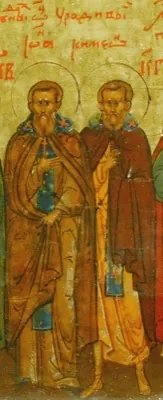
Venerable Symeon, Fool for Christ, and John, His Fellow Ascetic (+c. 590)
The Venerable Symeon, Fool for Christ, and his fellow ascetic John were Syrians and lived in the city of Edessa in the sixth century. From their youth they were sincere friends. The elder, Symeon, was unmarried and lived with his mother, who was already advanced in years, while the newly married John had his father and his young wife at home. When Symeon was thirty and John twenty-four, they travelled to the holy city of Jerusalem. Venerating the holy places and seeing the many monasteries there awakened in them the desire for the monastic life. The friends sent their servants home, and themselves set out for the monasteries built along the bank of the river Jordan. Symeon and John asked God to show them which monastery to choose, and decided to enter the monastery whose gates they found open. At that time the Lord told Nikon, the abbot of one of the monasteries, in his sleep to open the gates of the monastery. The holy friends came to the open gates of the monastery. By God’s will the superior received them with joy. The monastic life did not satisfy the friends, burning with divine zeal: the desire arose in them to go into the depths of the desert and labour there in solitude. God revealed the fellow ascetics’ intention to the abbot Nikon: on the very night when they meant to leave the monastery, he again opened the gates, then prayed with them and sent them off with his blessing on their heavy labour. Symeon and John firmly remembered the vows they had made at their tonsure. They prayed constantly, fasted strictly, worked, and strengthened one another in the struggle against temptations. After some time it was revealed to the fathers from on high that Symeon’s mother and John’s wife had entered into the blessedness of the Kingdom. The ascetics spent twenty-nine more years in the desert. By the Lord’s will the thought arose in Symeon that they ought to take up the service of their neighbour, for which it was necessary to go out into the world; but Saint John considered that he had not yet risen to that degree of dispassion and so could not leave the desert. Symeon set off for Jerusalem and venerated the life-giving tomb of the Lord and the other holy things. Out of his wonderful humility he fervently besought God to make him worthy of such a service of his neighbour as would not earn him their praise. The holy father chose the labour of foolishness for Christ. Having come to the city of Emesa, the blessed one behaved like a madman, and for his strange conduct endured mockery, abuse and beatings from many… but to those who insulted him he did a great deal of good: he cast out demons, healed the sick, saved those in danger from sudden death, converted unbelievers to the true faith and sinners to repentance… For these miracles and good deeds, done under the cover of feigned folly, he received neither praise nor a word of thanks.
The Venerable John valued his spiritual brother highly: if anyone from among the inhabitants of Emesa came to him in the desert for counsel, the desert-dweller would send him to Symeon the Fool. Three days before his death Symeon disappeared from the city. Common people of Emesa, who were friends of the saint, went to see him in his hut and found him dead there. It was they who paid their last respects to the God-pleaser: without church singing they carried him to the cemetery of strangers and the homeless and committed him to the earth. As the blessed one’s body was being carried, some of the city’s inhabitants heard wonderful, unearthly sweet singing, but could not tell where it came from. Soon the Venerable John too commended his soul to the Lord in peace in the desert.



