
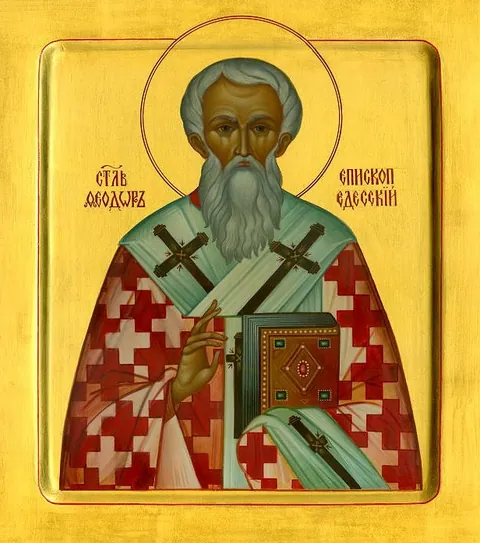
St Theodore, Bishop of Edessa (IX)
Saint Theodore, Bishop of Edessa, lived in the ninth century. His parents, pious Christians of Edessa, had an only daughter, and for a long time were not given the son they longed for. Theodore came into the world after his mother’s and father’s fervent prayers, but when he was sent to school his parents’ joy turned into sorrow: the child proved very weak at his studies. His elders punished the boy and his companions mocked him, while he himself fervently besought the Lord to grant him understanding. One day the boy came to church early in the morning, slipped into the sanctuary, crept under the altar table, and fell asleep there in prayer. The Divine Liturgy began, and the child dreamed of a radiant youth who fed him honey, put a staff in his hand and blessed him. Roused by the wondrous vision, Theodore crept out of his hiding place and told the astonished bishop of his vision. The hierarch understood that the boy’s prayer had been heard and that in future he would become the head of a church too, and so he enrolled the Lord’s chosen one among the clergy.
When Theodore was twenty his parents died. He gave away as alms the great property he had inherited, and set out for Jerusalem. After venerating the holy places he became a monk in the Lavra of Sabbas the Sanctified, began to live in seclusion in a secluded cell, and took upon himself the labour of silence as well. For many years his young kinsman Michael laboured with Saint Theodore; the Muslims who had taken possession of the Holy Land put him to death by torture.
After this the blessed Theodore did not stay long in the Lavra. After the death of the bishop of Edessa, by mutual agreement of the patriarchs of Antioch and Jerusalem and at the request of the clergy and laity, he was chosen hierarch of Edessa. For a long time the holy father refused, for it was hard for him to give up silence, but he could do nothing: within one week they raised him through the degrees of the hierarchy and consecrated him bishop. At his consecration a great miracle took place: the people saw a white dove, which first circled under the dome of the church and then came down upon Theodore’s head. On his way to his new field of labour the saint was seized by such deep sadness that he even tried to flee, but the Lord admonished him in a dream: “Be not like the slothful servant who buried his talent in the earth; imitate him who with five talents gained another five!” Theodore understood his mistake, subdued his own will and wisely took up the government of the Church: he instructed his flock by word and deed and fearlessly denounced the heretics… The holy hierarch was comforted and strengthened by his spiritual friendship with an aged stylite monk, the Venerable Theodosius. This ascetic lived near a monastery dedicated to Saint George, a little way from Edessa. In his youth he had withdrawn from the vanity of the world together with his elder brother John. The brothers laboured for three years in a monastery, and then settled in the desert near Babylon, in two separate caves, and gave themselves up to strict fasting and prayer. The ascetics met on Saturdays and Sundays for common prayer, and then parted again.
Once Theodosius, who had gone out into the desert to gather herbs, caught sight from afar of his brother, who was busy with the same task. John suddenly stopped, bent a little towards the ground, looked at something in amazement, then made the sign of the cross, jumped over the spot and hurried off to his cave. Puzzled by his brother’s strange behaviour, Theodosius went to the place and, astonished, saw a heap of gold. He prayed, took off his outer garment, put the treasure he had found into it, and with difficulty dragged it to his cell. The next day, without even taking leave of his brother, Theodosius set off for the city. Here he built a church, set up a monastery, founded a hospital and a shelter for the infirm, and made generous offerings for them; at last he distributed the rest of the wealth to the poor and turned back to the desert. Grown proud, Theodosius judged his brother in his heart because he had not known how to make use of the treasure he found. At this point an angel, who had often appeared to him before, stood before the monk. Now he seemed very angry. The Lord’s servant spoke sternly to the desert-dweller: “Why art thou exalting thyself? Truly I tell thee, thy works cannot compare with the feeling with which thy brother leapt over the gold. For then he gave up not only the treasure, but on light wings he crossed that gulf which is fixed between Lazarus and the rich man. John’s labour is immeasurably higher before God. In this life thou wilt never see him again, nor wilt thou see me, until by repentance and prayer thou hast softened the Lord’s heart.”
Theodosius went to his brother’s cave and, not finding him there, wept bitterly. A week later, as he was grieving beyond measure, he heard from afar the voice of the angel, who commanded him to go to Edessa. There Theodosius took up the labour of a stylite, pleased the Lord, and after five decades received from Him the grace of foresight as well. The holy father received those who came to him with love and instructed everyone diligently. Once, with the blessed elder’s blessing, the hierarch Theodore went on the affairs of the Church to Mavias, the caliph of Babylon. He found the caliph gravely ill. The saint asked the Lord for help, put into a cup of water some earth taken from the Saviour’s tomb, gave it to the sick man to drink, and healed him. The grateful Mavias believed in Christ and was baptised with the name John, together with three people close to him.
Soon, for openly confessing his faith before the Muslims, the caliph John (Mavias) and his brothers in Christ were put to death by his own subjects. On the night after his martyr’s end John appeared to Theodore in a spotless garment, with a radiant crown, and said to him: “May the Lord bless thee, for thou hast become the instrument of my salvation!” After this Theodosius the Stylite did not live long.
Theodore committed him to the earth with honour, and, himself forewarned of his approaching end, again by a miraculous appearance of John, three years later he left the see, withdrew to the Lavra of Sabbas the Sanctified, and commended his soul to the Lord in peace (IX).



