
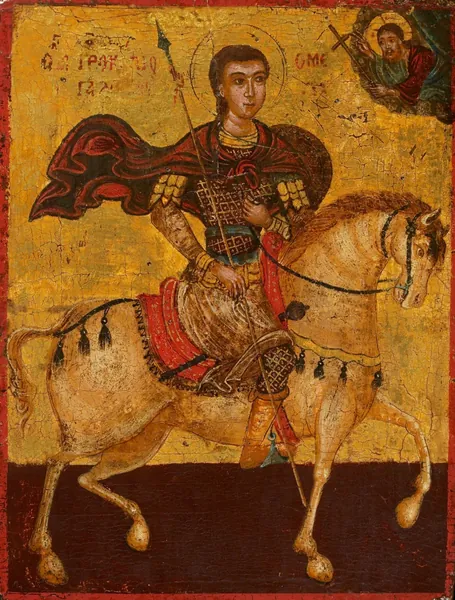
Great Martyr Procopius of Jerusalem (+303)
The holy Great Martyr Procopius (before baptism Neanias) was born in Jerusalem in the third century. His father, the noble Roman Christopher, was a Christian, while his mother worshipped the pagan idols. Neanias’s father died early, and the orphaned young man was brought up by his mother.
After receiving a brilliant secular education he was presented to the newly enthroned Emperor Diocletian, who liked the young man and appointed him commander of one of the units of his army. Around 303, when the cruel persecution of the Christians began, the lawless autocrat sent Neanias to Alexandria to deal with those who revered the true God. Because of the terrible heat he travelled mostly by night and rested by day. When they drew near to the Syrian city of Apamea, suddenly the earth shook violently, the sky thundered, and lightning split the darkness of the night. Everyone was seized with fear, and Neanias clearly heard: “Neanias, art thou too coming out against Me?” The soldier asked: “Who art Thou, Lord?” In answer the sign of the cross shone in the sky, and a voice was heard: “I am Jesus the Crucified, the Son of God.” After this miraculous revelation the grace of the Holy Spirit touched the pagan soldier’s heart; he was filled with inexpressible joy and, like Saul of old, he too turned from a cruel persecutor of Christ into His ardent follower. In the city of Scythopolis Neanias had a goldsmith cast a cross, on which, by an invisible hand, three figures appeared with the inscriptions “Emmanuel”, “Michael” and “Gabriel”.
Then the saint smashed the golden idols that were kept with honour in his own house, and gave away the pieces as alms. His angry mother denounced her Christian son to the emperor. The saint was summoned to Justus, the procurator of Judea, and handed the emperor’s letter. Neanias read the letter, which was full of blasphemy against God, and tore it up in front of everyone without a word. This was already a crime, “insult to his majesty”, and so the blessed martyr was seized and sent in fetters to Caesarea of Palestine. Here the confessor of Christ was cruelly tortured. The crowd gathered at the place of torture roared: “This is the enemy and destroyer of our gods, who mocks the king’s command!” Neanias noticed tears in the eyes of some, and said to them: “Weep not for me, but mourn the ruin of your own souls, for pitiable is he who shares in the endless torments of hell.”
When even the executioners themselves grew tired of torturing the martyr, he was thrown into prison. At night the cell shone with heavenly light; the Lord Jesus Christ appeared, accompanied by heavenly angels, healed His chosen one of his wounds, and called him Procopius, “the one who makes progress”. Then the Saviour encouraged the saint: “Take courage and be strong: I am with thee; through thee many will draw near to My heavenly Father.”
Procopius was brought before the tribunal many times. The godless demanded that he deny Christ and devised ever new torments for him. The firmness of the blessed one’s faith did indeed bring many to know the truth: the prison guards and the soldiers under the command of Antiochus and Nicostratus were converted to Christianity and died under torture; twenty Christian women adorned their heads with the martyr’s crown. At last Procopius’s pagan mother too believed in Christ and washed away her great sin with her blood. Seeing his own powerlessness, the procurator raged terribly. From his agitation he fell ill, grew weak and soon died. The new governor who came to the city, on learning what had happened, summoned Procopius and again demanded that he bow down to the idols. The valiant confessor again firmly refused and proved to him how groundless and feeble the faith of the pagans was. Then the tormentor tried to force the martyr at least outwardly to perform the sacrifice: a fire was lit on the altar, incense was put on Procopius’s palm, and he was made to hold it over the red-hot coals for two hours, in the hope that he would not bear the pain and would drop the incense onto the altar. This hope of the lawless too proved groundless: the ascetic, clothed by the Lord with the grace of wonderworking, did not even move his hand, and, rejoicing in spirit, went on boldly glorifying the Lord.
After this the blessed Procopius was tortured again, and at last he was sentenced to be beheaded. The Christians carried away the great martyr’s holy body by night and committed it to the earth with honour (+303).



