
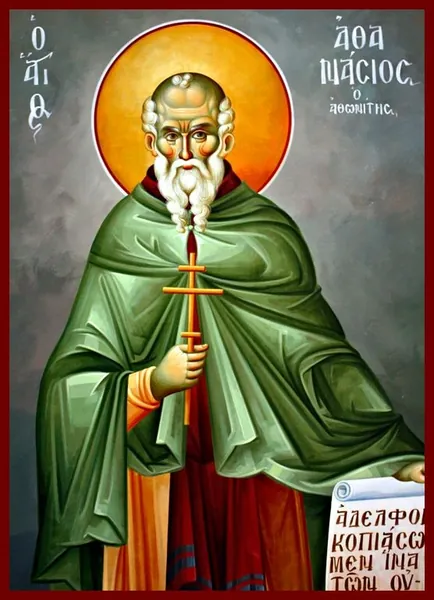
Venerable Athanasius of Athos (+1000)
The Venerable Athanasius of Athos (in the world Abraham) was born in the city of Trebizond. The boy’s parents died early, and a God-fearing nun took on the care of the orphan. From his foster-mother Abraham acquired the habits of a pious life and imitated her in prayer and fasting.
After his foster-mother’s death the young man was taken to Constantinople, to the court of the Byzantine Emperor Romanos the Elder (919–944), and was made a pupil of the celebrated rhetor Athanasius.
At that time the Venerable Michael Maleinos (commemorated 12 July), abbot of the monastery of Kyminas, came to Constantinople. Abraham revealed to him his sincere desire to dedicate his life to the Lord. The godly elder recognised in the young man a chosen vessel of the Holy Spirit, was filled with love for him, and for a long time diligently instructed him in the matters of salvation. Once, during a conversation on spiritual matters, they were joined by Michael’s kinsman Nicephorus Phocas, a renowned commander and later emperor. The loftiness of Abraham’s soul and the keenness of his mind filled him with deep respect for him. The saint’s desire for the monastic life grew into an irrepressible longing; he left everyone and everything, went to the monastery of Kyminas, fell at the abbot’s feet and asked to be tonsured a monk. Convinced of Abraham’s wisdom and holiness, the abbot soon tonsured him and named him Athanasius.
Under the guidance of the Venerable Michael Maleinos, Athanasius took up the ascetic life: he fasted strictly, prayed, and carried out every obedience with wonderful diligence. The Venerable Athanasius wished to eat bread only once a week, but Saint Michael, in order to cut off his disciple’s own will, ordered him to take food every third day, and to sleep on a mat, and not on a stool as he had done until then. The blessed Athanasius meekly followed the blessing. In the time free from his obediences he was occupied with copying books.
Through unceasing fasting, vigils, prostrations and God-pleasing labour Athanasius soon reached such perfection that the abbot gave him his blessing for silence and seclusion in a secluded place, and laid down a rule for him: to eat bread and drink a little water every other day, in Great Lent to take food only once in five days, to sleep sitting as before, and on Sundays and feasts of the Lord to keep vigil in prayer and glorification of the Lord from evening until the third hour of the day. The blessed one diligently kept the blessing, but out of love for hidden labour, and for fear that Saint Michael would hand over the headship of the monastery to him, Athanasius left the mountain of Kyminas. He took with him only a Gospel copied by his own hand, and went to Melana, the most remote place on Mount Athos. Here the saint made himself a small cell and settled in it. By valiant labour he rose gradually up the steps of the spiritual ladder and drew near to the summit of perfection.
The enemy of the human race tried to kindle in Athanasius a hatred for the place of his labours, and troubled him with evil thoughts. The blessed one decided to endure for one year and wait for the Lord’s will to be revealed. When on the last day of the appointed term Saint Athanasius stood in prayer, a heavenly light suddenly shone upon him; he was filled with inexpressible joy, was cleansed of evil thoughts, and grace-filled tears flowed from his eyes. From that time on Athanasius became wonderfully tender-hearted, and he came to love this place as strongly as he had loathed it before. At this time Nicephorus Phocas asked the holy father to build a monastery with his means.
The blessed Athanasius did not wish to burden his soul with earthly cares and refused to accept the gold, but later he discerned the divine will in all this and began to build the monastery. He built two churches, dedicated to John the Baptist and to the Most Holy Mother of God, and set up cells, a refectory, a hospital, a shelter for the infirm… and a wonderful monastery arose on the Holy Mountain.
Brethren came to the monastery not only from Greece but from other countries as well. The great Georgian fathers laboured here too: John (commemorated 12 July) and Euthymius (commemorated 13 May), John the former Tornike (commemorated 12 June)…
The holy abbot composed the rule of his monastery in imitation of the ancient monasteries of Palestine.
The Most Holy Mother of God herself, the Queen of Heaven, protected the saint. Many times he was made worthy of a vision of the All-holy Virgin. Once, by God’s will, a terrible famine began on Mount Athos. The monks, weakened in soul and body, left the Lavra one after another. Left all alone, the blessed Athanasius too was seized for a moment by faint-heartedness and meant to leave, but suddenly on the road a lady appeared coming to meet him, wearing a light, airy veil. “Who art thou, and where art thou going?” she asked quietly. Filled with an involuntary feeling of awe, Saint Athanasius stopped. “I am a monk of this place,” he answered, and told her of his plight. “And for a morsel of bread thou art leaving this monastery, which is destined to be glorified from generation to generation? Where is thy faith? Go back, and I will be thy helper!” “Who art thou?” Athanasius asked her. “I am the Mother of thy Lord,” the stranger replied, and commanded the saint to strike a rock nearby with his staff. From the crack burst forth a grace-filled spring, which to this day delights and refreshes with its good taste the monks and the pilgrims who come to the monastery.
The brotherhood grew. Building work continued in the Lavra. The Venerable Athanasius sensed the approach of his end; endowed with the gift of foresight, he also knew how he would depart this world, and he asked the brethren not to be scandalised by what would happen, for the human mind is powerless to comprehend God’s providence. The brethren were perplexed, but could not grasp the meaning of their teacher’s words. At last the venerable father instructed and comforted his spiritual children for the last time; he went into his cell, put on his mantle and prayed for a long time; then he came out and went with six brethren to inspect the dome of the church under construction. Suddenly the roof collapsed. Five monks gave up their souls on the spot, while the architect Daniel and Saint Athanasius remained alive. Everyone could hear how the father, caught in the ruins, was calling on the Lord: “Glory to Thee, O God! Lord Jesus Christ, have mercy on me!” Sobbing, the brethren began to roll away the stones, but under the heap of rubble they found only their teacher’s lifeless body (+1000).



