
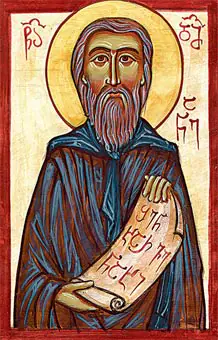
Venerable Damian, Formerly King Demetrius, Author of “Thou Art a Vineyard” (+1157)
The Venerable Damian, formerly King Demetrius, was the son of the holy and right-believing King David the Builder. The saint was born around 1095. The best masters of the sacred as well as of the secular and military sciences cared alike for Demetrius’s upbringing; as the chronicler writes, Demetrius “in wisdom, holiness, valour and vigour surpassed Nani”.
In 1125 the holy King David set Demetrius on the royal throne in his own lifetime, “placed the crown upon him with his own hand” and “girded his mighty loins with the sword”.
Already in the reign of David the Builder Demetrius won name and glory: in 1117 David sent him on campaign to Shirvan. The young commander “fought such battles and combats that he amazed all who saw him”, took the fortress of Qaladzori and returned victorious with countless captives and spoil.
Saint Demetrius set about bravely guarding his father’s inheritance and the borders of Georgia. In Demetrius’s reign Hereti, Somkhiti, Tashiri, Javakheti, Artaani and Tao revived, which after David the Builder had taken Tbilisi and annexed Hereti-Kakheti had been almost empty of people.
The victorious King Demetrius did not escape the machinations of the evil one: the God-planted and anointed king, like the good root of the house of David, became the victim of plots and treachery. First the great nobles rose against him, wishing to set on the throne his half-brother, Vakhtang (Tsuata). Demetrius swiftly put down the revolt directed against the strength of a united Georgia. Then his own son, David, rose against his father. Wounded to the heart by his beloved son’s treachery, the right-believing king tasted the vanity of this world in its sharpest form; he was tonsured a monk with the name Damian and shut himself away in the desert of David Gareja, yielding the royal throne to David. David reigned only six months and died.
To protect the interests of the country, Demetrius vigorously intervened in the affairs of state, again ascended the throne and proclaimed his son George co-ruler.
The king tonsured in the desert of David Gareja left to posterity fine examples of hymnography. Of the iambic hymns that have come down to us, the most famous is the praise of the Theotokos: “Thou art a vineyard newly blossomed, a fair young shoot planted in Eden, a fragrant poplar grown up in Paradise; God has adorned thee, none surpasses thee in praise; thou art of thyself the shining sun.” In the words of Catholicos Anton, Demetrius was “a composer of verses in lofty metres, which are still seen written down today”. And Prince Ioane writes that “he was a fine rhetorician, a poet and a composer of wondrous verses, who uttered many teachings”.
A fresco of the right-believing king and Saint Damian has been preserved in the paintings of the church of Matskhvarishi (Latali).
Demetrius-Damian, a man of deep spirituality and firm Christian faith, completed and consecrated the church of Gelati begun by the great David. The former king, Saint Damian, died in the fortress of Belti (+1157) and was buried in the monastery of Gelati.



