
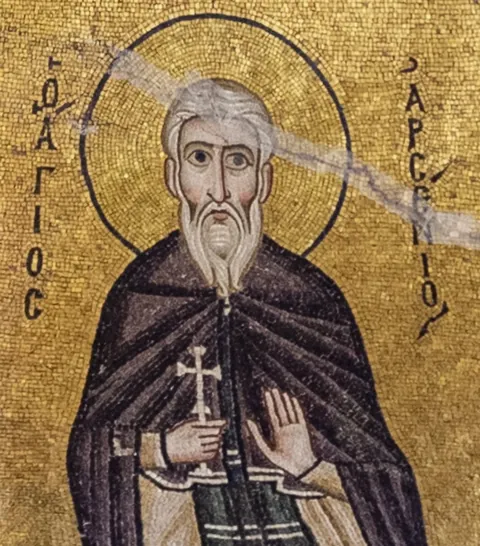
Venerable Arsenius the Great (+449–450)
The Venerable Arsenius the Great (+449–450) was born in 354 in Rome, into the family of a pious Christian; his deep faith roused in the young man the desire to break off the study of the sciences and dedicate himself to the service of God. Soon Saint Arsenius was ordained deacon.
The Emperor Theodosius (379–395), ruler of the East of the Roman Empire, learned of his education and piety and entrusted him with the upbringing of his sons Arcadius and Honorius. Against his will Arsenius was forced to submit to the emperor’s wish. The holy father was then twenty-nine.
When Saint Arsenius arrived in Constantinople, the Emperor Theodosius received him with great honour and asked him to bring up the princes in the fear of God: “Though they are princes, they must obey thee in everything, as a father and teacher.”
The venerable father set diligently about bringing up the boys, but the great honour with which he was surrounded weighed on his soul, which was called to the monastic life and to silence. Saint Arsenius fervently besought the Lord to show him the way of life. The Lord heard him, and once the holy father heard a voice from heaven: “Arsenius, flee from men, and thou shalt be saved.” Saint Arsenius took off his rich garments, secretly left the palace, boarded a ship and went to Alexandria, and from there made for the desert. Coming to a monastery, Saint Arsenius asked the superior to receive him into the brotherhood. The saint was brought to the Venerable John the Dwarf (commemorated 9 November). To test Saint Arsenius’s obedience the Venerable John did not seat the newcomer at the table, but threw him a piece of bread and said: “Eat, if thou wilt.” The Venerable Arsenius obediently fell on his knees, received the bread with gratitude, and stood in a corner. Saint John said: “He will be a very great ascetic,” and joyfully tonsured him a monk.
The Venerable Arsenius began his labours zealously and soon surpassed many fathers of the desert. Once, during prayer, he again heard a heavenly voice: “Arsenius, flee from men, keep silence, for this is the root of sinlessness.” The Venerable Arsenius settled in a solitary cell and took up the labour of silence. He seldom went out, going to church only on feast days and Sundays. To a monk who asked why he had withdrawn from people, the saint answered: “God sees that I love everyone, but I cannot be with God and with men at the same time.”
The fame of the great ascetic spread far and wide. Many wanted to see him, and this broke the venerable father’s vow of silence, so the saint was forced to change his dwelling often, but those who wished to see him still managed to find him.
Once a monk asked Saint Arsenius what he should do when, reading the psalms, he did not understand the meaning of the words. The holy elder answered that one must go on reading the psalms, for the evil powers flee from a man when they hear the words of Holy Scripture.
The monks often heard Saint Arsenius say: “Toil, Arsenius, do not be lazy; thou didst not come here to rest, but to labour.” The holy elder would often say: “Many times have I repented of words I have spoken, but never of silence!”
The holy father spent fifty-five years in monastic labour, earned from his contemporaries the name “the Great”, and died at the age of ninety-five, in 449 or 450.



