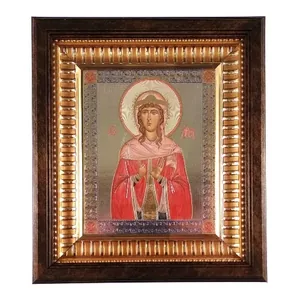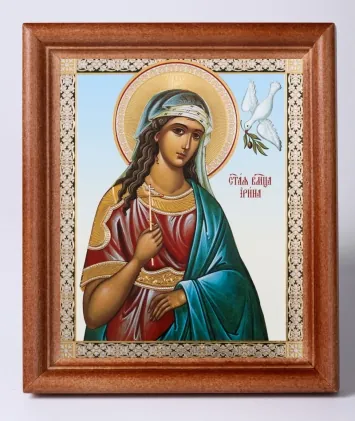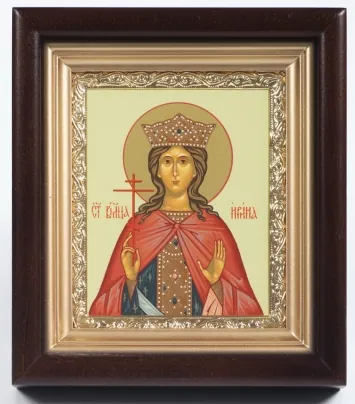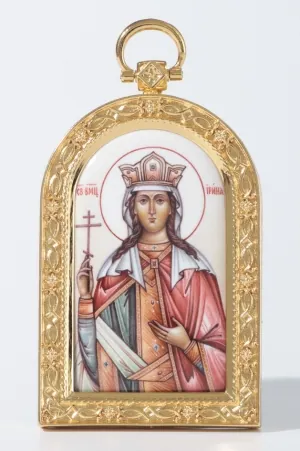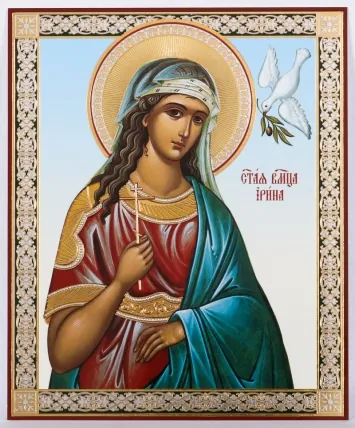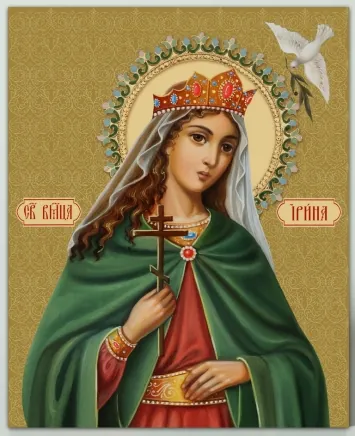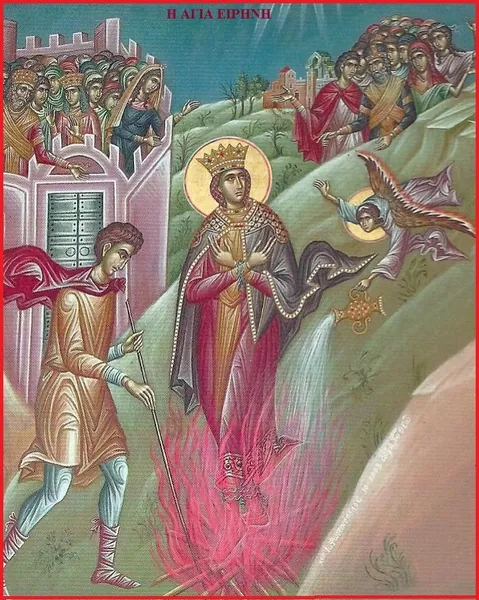
Holy Great Martyr Irene (I–II)
The holy Great Martyr Irene lived in the first century. Before her baptism her name was Penelope. She was the daughter of the pagan Licinius, ruler of the city of Magedon (Macedonia, or Thrace). Licinius built his daughter a rich palace, where she lived with her tutor Carea, surrounded by companions of her own age and by servants. A teacher named Apellian came to Penelope every day and taught her various sciences. Apellian was a Christian. During the lessons he told the girl about Christ the Saviour. When Penelope grew up, her parents decided to marry her. At that time the Lord granted her a wonderful vision: there flew to her a dove with an olive branch, an eagle with a crown, and a raven with a snake. Apellian explained to Penelope the meaning of this vision: the dove, the image of the virtues of obedience, humility and purity, had brought her an olive branch, the grace of the Lord, which every person receives in baptism. The eagle, the symbol of spiritual height, had brought her a crown, the reward granted by the Lord for victory over the powers of evil; and the raven had brought a snake as a sign that the devil would rise against her and bring the saint sorrow and persecution. At the end of the conversation Apellian said that the Lord had chosen Penelope and that she would have to endure many torments for the heavenly Bridegroom. Penelope refused marriage, was baptised by the Apostle Timothy, a disciple of the holy Apostle Paul, and was named Irene. She wished to make her parents Christians too. Her mother rejoiced at her daughter’s conversion. Her father at first did not oppose his daughter, but then demanded that she worship the pagan deities. When Saint Irene firmly refused her father’s demand, the enraged Licinius ordered the virgin to be bound and thrown under the hooves of unbroken horses. The horses stood still before the saint, and at last one of them broke loose, broke Licinius’s right shoulder, and trampled him. The holy virgin was set free. Through her prayer, before everyone’s eyes, Licinius’s arm was healed. Seeing this miracle, Licinius, his wife and three thousand people believed in Christ and renounced paganism. Licinius gave up the government of the city, settled in Saint Irene’s palace, and wished to devote himself to the service of Jesus Christ. Saint Irene began to preach the teaching of Christ among the pagans. She lived in the house of her teacher Apellian. The new ruler of the city, Sedecias, summoned the holy virgin and demanded that she offer sacrifice to the idols. Saint Irene fearlessly confessed Christianity and prepared herself for the struggle of martyrdom. By Sedecias’s order the saint was thrown into a pit full of snakes, where she spent ten days. She was kept unharmed by an angel of the Lord, who brought her food. Sedecias ascribed this miracle to sorcery and ordered the virgin to be sawn apart. The iron saws broke and could do the holy martyr no harm. At last the fourth saw stained the martyr’s body with blood. Sedecias asked the saint mockingly: “Where is thy God, why does He not help thee?” Suddenly a storm arose, lightning flashed, thunder crashed and torrential rain fell. Sedecias prepared new torments for the martyr, but God again kept His chosen one unharmed. The people were outraged, rose against Sedecias, and drove him out of the city. The rulers who replaced him also tortured Saint Irene, but God protected her still. And the people who saw her preaching and her miracles became Christians. Ten thousand pagans were converted by Saint Irene. The saint moved from her city to Callipolis and continued her preaching there. The ruler of the city, Babadon, seized and tortured the virgin, but by God’s will he himself was converted to Christianity. Many pagans accepted the law of Christ with him. They were baptised by the hand of Saint Timothy. After this Saint Irene travelled through other cities of Thrace preaching. In Ephesus the Lord revealed to her that the time of her departure from this world was near. Saint Irene went out of the city with Apellian and other Christians, came to a cave, made the sign of the cross, asked her companions to seal the entrance with a large stone, and went inside. On the fourth day the Christians went into the cave, but did not find the saint’s body.