
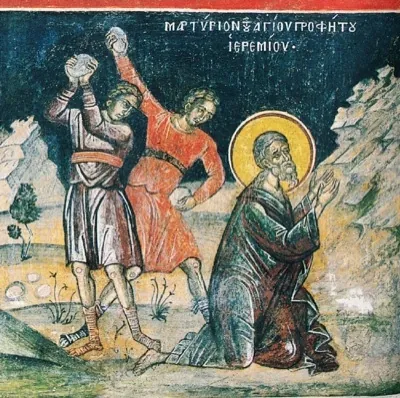
Holy Prophet Jeremiah (VI c. BC)
The holy Prophet Jeremiah, one of the four great prophets of the Old Testament, was the son of Hilkiah, a priest of Anathoth. He laboured in the hardest period of the history of the Jewish state, in the reign of Josiah, king of Judah, and his four successors. At fifteen it was revealed to Jeremiah that he had been called to be a prophet before his birth. He was afraid of so great and heavy a ministry, for he was still a child and inexperienced, but the Lord promised him His support and protection. “Then the LORD put forth his hand, and touched my mouth. And the LORD said unto me, Behold, I have put my words in thy mouth. See, I have this day set thee over the nations and over the kingdoms, to root out, and to pull down, and to destroy, and to build, and to plant” (Jer. 1:9–10).
Jeremiah did everything in his power to save his countrymen, weighed down by sins, from the wrath of God that awaited them. For twenty-three years he prophesied, preaching in the temple of Jerusalem, at the city gates, in the king’s palace, in the squares and other crowded places, and denouncing the Jews for falling away from the true God and for idol-worship.
As a sign of the coming enslavement of the Jews by the Babylonians, by God’s command Jeremiah wore on his neck first a wooden and then an iron yoke. Shaken by his terrible prophecies, the Jewish elders threw Jeremiah into a filthy pit, where he faced death from hunger and damp, had not a God-fearing eunuch, Ebed-melech, rescued him.
Jeremiah’s prophecy was soon fulfilled: Nebuchadnezzar, king of Babylon, conquered Judea, slaughtered the people, carried off those who were left into captivity, and plundered and laid waste Jerusalem. Jeremiah himself was set free and even given the choice to go to Babylon or stay in his homeland. Jeremiah stayed in the ruined city, for he considered that his presence in Judea could bring more benefit to the people. According to tradition, the prophet hid the Ark of the Covenant in a cleft of Mount Nebo, so that the Jews could not find it (2 Macc. 2). Later a new ark was made, but it did not have the glory of the old one.
Enmity broke out among the Jews who stayed in the homeland. Gedaliah, whom the Chaldeans had appointed governor in Judea, was treacherously killed by a Jewish commander, who then fled the wrath of the avengers and took refuge with the Ammonites. Most of the Jews fled to Egypt. Jeremiah himself, in spite of his resistance, was taken to the Egyptian city of Tahpanhes. He lived there for four years and enjoyed great respect among the Egyptians. When Jeremiah foretold the invasion of Egypt by the Babylonians and the slaughter of the Hebrews living there, the Jews stoned the prophet to death. That same year Jeremiah’s prediction came true. There is a tradition that 250 years later Alexander of Macedon translated the prophet’s remains to Alexandria.
To Jeremiah belong the Old Testament book of “Lamentations” over the destruction of Jerusalem, and an epistle. The period of his ministry is spoken of in the Second Book of Kings (23, 24, 25), the Second Book of Chronicles (36:12) and the Second Book of Maccabees (2).
The Gospel of Matthew points out that Judas’s betrayal of the Saviour was foretold by Jeremiah: “Then was fulfilled that which was spoken by Jeremy the prophet, saying, And they took the thirty pieces of silver, the price of him that was valued, whom they of the children of Israel did value; and gave them for the potter’s field, as the Lord appointed me” (Matt. 27:9–10).



