
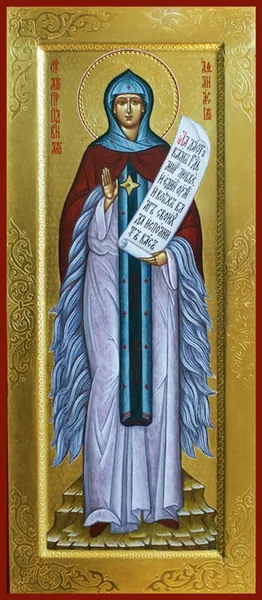
Venerable Athanasia the Abbess (+860)
The Venerable Athanasia (+860) was abbess of a monastery on the island of Aegina. She was born into the family of the pious Christians Nicetas and Marina. At the age of seven the girl knew the Psalter by heart. Once, as she sat at the loom, she saw a shining star come down from above and vanish by her fingers. After this the child’s soul was enlightened, and she firmly resolved to go to a monastery.
When Saint Athanasia turned sixteen, she married at her parents’ request, but sixteen days after the wedding her husband was taken off to war and was killed.
Widowed, Athanasia decided to fulfil her long-held desire, but just then a decree of the Emperor Michael (820–829) came out, by which young widows were to be married to soldiers. Saint Athanasia was forced to marry. In marriage she lived piously and kindly: she worked, helped the sick and the needy, received wanderers and travellers, and on Sundays and feast days invited her neighbours to her house and read Holy Scripture to them. Under her influence her husband went to a monastery and allowed Saint Athanasia too to take the veil.
The saint gave away her property and withdrew with other God-fearing women to a quiet place. Some time later, at the sisters’ request, Saint Athanasia became abbess of this small community. She was an example to the other nuns.
Although Saint Athanasia bore the title of abbess, she still considered herself the least among the sisters and always remembered the Saviour’s commandment: “Whosoever will be chief among you, let him be your servant” (Matt. 20:27).
The Venerable Athanasia wore sackcloth, and over the sackcloth a garment of coarse sheep’s wool; she slept little, prayed all night, and by day worked with the sisters; she ate only in the evening, and then only a piece of bread and a cup of water; oil, cheese and fish she took only at Christmas and Pascha; during the fasts she took greens once every two days. The venerable mother spent four years in this community.
On the island of Aegina there lived an old monk named Matthew, who blessed the nuns to move to a more remote place. Saint Athanasia built a monastery on a desolate mountain of the island, near an old church of Saint Stephen the Protomartyr.
The venerable mother was granted by God the gift of wonderworking. Many people came to her to receive healing of soul and body. With the offerings Saint Athanasia built three churches: of the Most Holy Mother of God, of Saint John the Baptist, and of Saint Nicholas the Wonderworker.
To escape honour and glory, Saint Athanasia with two spiritual sisters, Maria and Eupraxia, went secretly to Constantinople and for seven years lived in one of the monasteries the life of a simple nun.
Her holy life drew attention once again. The sisters of the monastery on Aegina learned where their abbess was and asked her to come back. Submitting to God’s providence, the saint returned to the monastery. Soon she was granted a divine revelation: two beings clothed in light handed her a scroll on which was written: “Here is thy freedom; take it and rejoice.”
The Venerable Athanasia spent her last twenty days in unceasing prayer. Before the feast of the Dormition of the Most Holy Mother of God she called the sisters, told them that she had been able to read only nineteen psalms, and asked them to finish reading the psalms in the church. The sisters did the abbess’s will and came back. Saint Athanasia blessed the sisters, asked them to celebrate the feast of the Dormition worthily, to lay a table for the poor, and after the Divine Liturgy to bury her body. With these words the Venerable Athanasia reposed in God (+14 August 860).
On the fortieth day, at the Divine Liturgy, some sisters distinguished by their piety saw Saint Athanasia standing at the doors of the altar. Two young men clothed in light set a crown bearing a cross on her head, put a shining staff in her hand, and led her through the Royal Doors into the altar.
Before her death Saint Athanasia had left instructions that the poor be fed for forty days in her memory. The sisters laid the memorial table for only nine days. The saint appeared to several sisters and said: “Remembrance for forty days and the giving of alms help sinful souls greatly”; then she struck the ground with her staff and vanished. The next day a spring appeared in that place. A year after the death of the Venerable Athanasia a woman tormented by the evil one was brought to her grave. When they dug up the earth they smelled a fragrance, and took out the coffin. As soon as the possessed woman came near it she was healed. They opened the coffin and saw the saint’s incorrupt, myrrh-flowing body. The Venerable Athanasia looked as if asleep: her face shone, her body was soft, her fingers bent. When the saint was laid in a new coffin, the sisters wanted to take off her sackcloth and clothe her in a silk garment, but the Venerable Athanasia’s hands were so tightly clasped to her breast that they could not change her clothing: even in death she remained a lover of simplicity and poverty. Then one sister knelt by the saint’s remains and begged her: “Our mistress, hear our request as thou didst hear us in thy lifetime; let us adorn thee with this garment, accept from us this small gift.” And the Venerable Athanasia rose up as though alive and opened her hands.



