
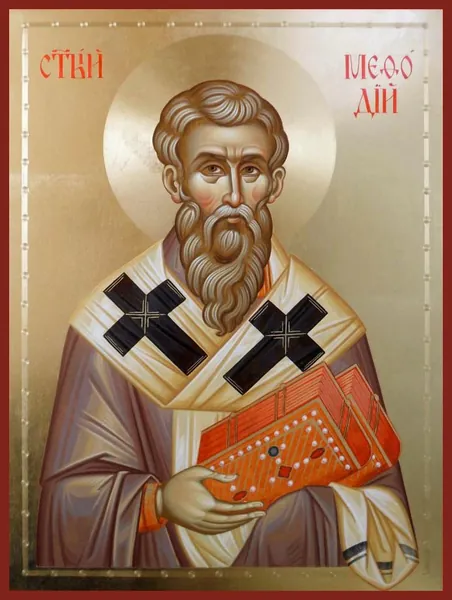
St Methodius, Archbishop of Moravia (+885)
Saint Methodius, Archbishop of Moravia (+885), and Cyril (+869) were children of a distinguished and pious family, natives of the Greek city of Thessalonica. Saint Methodius at first was in military service and governed one of the Slavic principalities within the Byzantine Empire. It is thought that after ten years of service in Bulgaria Saint Methodius was tonsured a monk on Mount Olympus. Saint Cyril was distinguished from childhood by great gifts and studied together with the future emperor Michael. He brilliantly mastered all the sciences of his time and many languages. After finishing his studies he received priestly ordination and became keeper of the patriarchal library, but soon went secretly to a monastery. Saint Cyril was sought out, brought back to the capital, and appointed teacher of philosophy at the high school. While still quite young, Saint Cyril defeated in debate Annius, the leader of the iconoclast heretics. Then, by order of the emperor, he took part in a disputation with the Saracens on the teaching of the Holy Trinity, won there too, and went to his brother, Saint Methodius, on Mount Olympus.
Soon the emperor summoned both brothers and sent them to the Khazars to preach the Gospel. The brothers stopped for a short time in the city of Korsun and miraculously uncovered the holy relics of the holy Hieromartyr Clement of Rome (commemorated 25 November).
After preaching in Khazaria Saint Cyril stayed in the capital, while Saint Methodius was chosen abbot of the Polychron monastery near Olympus.
Soon envoys of Rostislav, Prince of Moravia, came to the emperor and asked him to send to Moravia teachers who knew Slavonic to preach the word of God. The emperor entrusted this great work to Saint Cyril. The holy father set about preparing for the hard labour with prayer and fasting. With the help of his brother, Saint Methodius, and of his disciples Gorazd, Clement, Sabbas, Naum and Angelar, he composed the Slavonic alphabet and translated into Slavonic the Gospel, the Apostol, the Psalter and other service books. This happened in 863.
After translating the books the holy brothers went to Moravia and began to celebrate the divine services in Slavonic. This roused the anger of the German bishops, who used Latin in the services. The bishops were defeated in debate with the holy brothers, Equal to the Apostles, but denounced them to the Pope of Rome. The brothers were summoned to Rome. The saints took with them the relics of Saint Clement of Rome. Pope Adrian of Rome received the brothers with honour and approved the celebration of the divine services in Slavonic.
In Rome Saint Cyril grew weak, was told that his end was near, and took the schema. Fifty days after taking the schema, on 14 February 869, Saint Cyril died at the age of forty-two.
After the death of Saint Cyril, Saint Methodius was consecrated Archbishop of Moravia and Pannonia. The holy father went on preaching and celebrating the services in Slavonic. The enraged German bishops brought about Saint Methodius’s arrest and exile to Swabia, where he suffered for two and a half years. Set free by order of the Pope of Rome, Saint Methodius baptised the Czech Prince Bořivoj and his wife Ludmila (commemorated 16 September). For the third time the German bishops raised a persecution against Saint Methodius, for his rejection of the Latin teaching on the procession of the Holy Spirit from the Father and the Son. Saint Methodius was summoned to Rome. Before the pope he proved the truth of the Orthodox teaching and was restored once more to the rank of hierarch.
At the end of his life Saint Methodius, with the help of two disciples, translated into Slavonic the Old Testament, except the books of the Maccabees, as well as the Nomocanon and the Paterica.
Saint Methodius died on 6 April 885, at the age of sixty. The funeral service was celebrated in three languages: Slavonic, Greek and Latin. The saint was buried in the cathedral church of Velehrad.



