
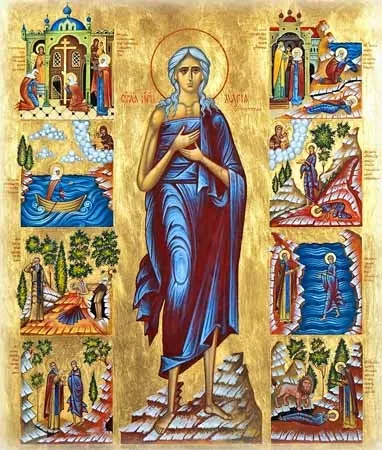
Venerable Mother Mary of Egypt (+522)
The Venerable Mary of Egypt (+522). In one of the monasteries of Palestine, near Caesarea, lived the Venerable Zosimas. Brought up in the monastery from his youth, the monk had laboured there until the age of fifty-three. Once a thought flashed through his mind: “I wonder whether there is to be found, in the farthest desert, a spirit-bearing man who surpasses me in watchfulness and ascetic labour?”
As soon as he had finished the thought, an angel of the Lord appeared to the venerable father and said to him: “Thy labours are pleasing to the Lord, but ‘there is none righteous, no, not one’ (Rom. 3:10). There are better ways of salvation on earth. Go out from thy monastery, as Abraham from his father’s house (Gen. 12:1), and go to the monastery by the Jordan.”
Abba Zosimas left his dwelling and came to the monastery by the Jordan. Here he saw the greatest ascetic fathers engaged in wonderful labours, and he stayed with them to struggle alongside them.
Time passed. Great Lent came. According to the tradition of the monastery, on the first Sunday of Great Lent all received Communion at the Divine Liturgy. After prayer and prostrations the monks asked one another’s forgiveness, received the abbot’s blessing, and went out into the desert singing the psalm: “The Lord is my light and my salvation; whom shall I fear? The Lord is the defender of my life; of whom shall I be afraid?” (Ps. 26:1).
Some monks took a little food with them, while others ate only herbs. They crossed to the other side of the Jordan, went their separate ways, and returned to the monastery for the feast of Palm Sunday.
That year Abba Zosimas too went into the desert.
Once, after twenty days spent in the desert, as the Venerable Zosimas was chanting the psalms and prayers of the Sixth Hour, it seemed to him that the shadow of a human figure flickered to his right. The venerable father was startled, thinking he had seen a demonic apparition; he made the sign of the cross and cast off his fear, and when he had finished his prayer he looked in that direction and saw a naked person walking in the desert, whose body had been blackened by the sun and whose short, faded hair had turned white like a lamb’s fleece. Abba Zosimas rejoiced at the sight of a living being and hastened towards it.
As soon as the naked desert-dweller saw Zosimas coming towards it, it tried to run away from the venerable father. Zosimas too forgot his weakness and weariness and pursued, wanting to see the wonderful hermit close at hand. At last, exhausted, he stopped by a dried-up stream-bed and besought the desert-dweller with tears: “Why dost thou flee from a sinful old monk who has come into the desert for salvation? Wait for me, weak and unworthy as I am; pray for me and bless me.”
Without looking back the stranger called to him: “Forgive me, Father Zosimas, I cannot come near thee; I am a woman and have no garment to cover the nakedness of my body. If thou wouldst pray for the greatest of sinners, give me thy garment, so that I may come near thee and ask thy blessing.”
“For her holiness and fierce ascetic labours the Lord must have granted her the grace of spiritual vision; that must be why she knows my name,” Abba Zosimas thought, and he threw her his rason.
Clothed, the woman came up to the venerable father: “What made thee wish, father, to speak with me, a sinful and foolish woman? What canst thou learn from me, and why hast thou spent so much strength?”
The Venerable Zosimas knelt and asked the desert-dweller for her blessing. She too fell to her knees. For a long time they asked each other for a blessing. At last the desert-dweller said to him: “Abba Zosimas, it is fitting for thee to bless and to offer prayer, for thou hast been made worthy of the rank of a priest, and for many years, standing at the altar of Christ, thou hast offered the Holy Gifts to the Lord.”
These words frightened the Venerable Zosimas still more: “Spiritual mother, it is plain that thou art nearer to the Lord and hast died to the world, since thou didst address by name one wholly unknown to thee and didst call me a priest; bless me, for God’s sake.”
At last the venerable mother said: “May the Lord, the Saviour of all the world, bless thee.” Abba Zosimas answered: “Amen,” and both rose to their feet. The desert-dweller spoke to Zosimas again: “Why hast thou come, father, to a sinner such as I? It seems that the grace of the Holy Spirit has brought thee to do a service needful for my soul. Tell me, father, how do the Christians live, how does the holy Church of God grow?”
Abba Zosimas answered: “Through your holy prayers the Lord has granted peace to the Church and to the whole world. Heed the entreaty of an unworthy monk, mother: pray for the world and for me, a sinner, that my wandering in the desert may not be fruitless.”
The holy desert-dweller answered: “Thy prayer, Abba Zosimas, for me and for others will be pleasing to the Lord, for thou hast the grace of ordination. But I will do thy will in obedience and pray with a pure heart.”
The desert-dweller turned to the east, raised her eyes and hands to heaven, and stood in prayer. The monk saw that as she prayed the venerable mother rose up into the air. Shaken by the miraculous sight, Zosimas fell face down on the ground.
Again a thought flashed through Zosimas’s mind: “Is the evil one not deceiving me?” Then the venerable mother raised him up and said to him: “Why art thou confounded, father? I am not an apparition but a sinful, unworthy woman,” and then she made the sign of the cross. Seeing and hearing this, Zosimas, in tears, fell at the desert-dweller’s feet: “I beseech thee, for God’s sake, do not hide thy story from me; tell it to me, that the greatness of God’s providence may be made plain to others too. The Lord sent me into the desert so that what was hidden might be revealed.”
The desert-dweller said to him: “It grieves me, father, to tell thee my shameless deeds, for thou wilt shun me as an asp. Yet I will tell thee everything, and do thou pray for me, a sinner.
I was born in Egypt, and while my parents were still alive, at twelve years old, I ran away to Alexandria. There I became a slave to the unbridled, insatiable passion of fornication. For seventeen years I lived in sin, and I did this unworthy thing for nothing. It was not because I was rich that I refused money; no, I had no livelihood, I lived in poverty and kept myself by weaving, but I thought that the whole meaning of life was the satisfaction of fleshly passion.
Once I saw a great crowd of people who were travelling from Libya and Egypt to Jerusalem for the feast of the Exaltation of the Holy Cross. I too wanted to go with them, but not to attend the feast, father; I thought that there I would surely find more people to fall into sin with. Believe me, I wonder now how the sea endured my adultery and lust, how the earth did not swallow me down into hell, how it forgave me for tempting and destroying so many souls; but it seems the Lord wanted my repentance and waited patiently for my conversion.
I came to Jerusalem, and until the feast I went on doing my foul deeds.
On the day of the Exaltation I went out, as usual, to lead young souls to perdition. Everyone had gone early to the church where the life-giving Cross was laid out. I too went there and stopped at the church gate. When the hour of the elevation of the holy Cross came, I wanted to go into the church, but an invisible power of God stopped me and turned me back from the door. Others went through the gate without hindrance. Again I tried to get inside, but in vain: some power kept throwing me back; this happened several times, until at last my strength failed me, I went away from the door and stopped in a corner nearby.
Suddenly I understood that it was because of my sins that I could not enter the church. My heart was filled with the grace of God; I began to weep and beat my breast in repentance. I noticed before me an icon of the Mother of God and turned to her in prayer: ‘O All-holy Virgin, who didst give birth to God the Word, I know that I am unworthy to look upon thine icon; I am cast out from thy holiness; but did not our God take flesh for the repentance of sinners?! Help me, O All-holy one, let me enter the church and see the Cross on which the Lord was crucified, shedding His sinless blood for the forgiveness of our sins. Let me bow down before the holy Cross; be my intercessor before thy Son. From henceforth I will no more defile my body with fleshly passions; when I have seen the all-holy Cross of thy Son, I will leave this world and go wherever thou shalt call me.’
As soon as I had finished the prayer, I felt that my prayer had been heard. Trusting in the mercy of the Mother of God, I went towards the door again, entered the church without hindrance, and was counted worthy to see the life-giving Cross of the Lord.
So I came to believe in God’s providence and goodness. I bowed down, kissed the holy things, and quickly came out of the church. Again I knelt before the icon of the Mother of God and raised a prayer.
Suddenly I heard a voice from afar: ‘If thou crossest the Jordan, thou shalt find a blessed end.’ I believed that these words were spoken for me to hear, and with tears I besought the Most Holy Mother of God: ‘Merciful Mother, do not forsake me, but help me.’ As I came out of the church courtyard, someone gave me three copper coins. With that money I bought three loaves, and asked the way to the Jordan.
At sunset I reached the church of Saint John the Baptist on the bank of the Jordan. After praying in the church I washed my hands and face in the water of the holy river, ate half of one loaf, received the Holy Mysteries, and lay down on the ground to sleep. In the morning I found a small boat, crossed to the other bank of the Jordan, and again asked the Mother of God to guide me. So I came into the desert.”
Abba Zosimas asked the desert-dweller: “How many years, mother, hast thou lived in the desert?” “It must be forty-seven years since I left the holy city.”
Zosimas asked her again: “What dost thou eat, what dost thou find in this desert?” “When I crossed the Jordan I had two and a half loaves. Little by little the scorching heat of the desert dried them out and turned them to stone. So I took a little at a time, and it lasted me many years.” “Believe me, Abba Zosimas,” the venerable mother went on, “for seventeen years I struggled with evil thoughts as with raging beasts. I remembered the meat and fish I had grown used to in Egypt. I longed for wine too: for I used to drink a great deal, whereas here I often had not even meagre food and drink, and I suffered from thirst and hunger. I had to bear a still greater misfortune: at times a craving for lewd songs would come over me; it was as if I actually heard them, and they troubled my heart and my hearing. Then with tears I remembered the promise I had given to the Mother of God, and prayed fervently. When my prayer was pleasing to the Lord, I saw a radiant light, and in place of the storm a glorious stillness settled.
How shall I confess to thee, father, my lustful thoughts? Suddenly the fire of fornication would seize my heart, consume everything within me, and waken passion. Then I would fall face down on the ground. So I lay prostrate day and night, until repentance came and the light appeared that scattered the evil thoughts and designs.
So I lived the first seventeen years: darkness upon darkness, misfortune upon misfortune was added to me, but the intercession of the Most Holy Mother of God sheltered me always.”
Abba Zosimas asked her again: “Didst thou need neither food nor clothing?”
The desert-dweller answered: “In seventeen years my bread ran out; after that I lived on roots and herbs. My dress fell to pieces, and for a long time I suffered in the heat of summer and the cold of winter. How many times have I fallen to the ground as if dead, how many times have I struggled with temptation, misfortune and trial; from that day to this the power of God has invisibly guarded, and guards, my sinful soul and body.”
Abba Zosimas was amazed at the desert-dweller’s knowledge of Holy Scripture, and asked her: “Where didst thou learn Holy Scripture, mother?” The desert-dweller smiled and answered: “Believe me, since I crossed the Jordan I have not seen a living soul; I cannot read or write, nor have I ever heard church singing; only the word of God, living and creative, teaches a man all things (Col. 3:16; 2 Pet. 1:21; 1 Thess. 2:13). I have confessed my whole life before thee, father; I beseech thee, pray for me, a sinner! One more thing I ask of thee, Abba: tell no one my story until the Lord calls me to Himself. Do what I shall tell thee. Next year, in Great Lent, do not go into the desert, as the monastic rule requires of thee.” Again the Venerable Zosimas was amazed: how did she know the rule of the monastery?
The desert-dweller went on: “Father, stay in the monastery; though even if thou wouldst, thou shalt not be able to go out. On Great Thursday, the day of the remembrance of the Mystical Supper, bring the life-giving Body and Blood of the Saviour to the bank of the Jordan, that I may receive Communion. For now tell no one anything about me; the Lord Himself will show thee the time.”
The desert-dweller prayed and vanished into the depths of the desert. Father Zosimas spent the whole year in silence and besought the Lord to let him meet the holy ascetic once more.
When the first week of holy Great Lent came again, the Venerable Zosimas stayed in the monastery because of illness, and remembered the desert-dweller’s prophecy. A few days later he recovered, but he did not leave the monastery until Passion Sunday.
The day of the remembrance of the Mystical Supper drew near. Abba Zosimas kept his promise: late at night he left the monastery and sat down on the bank of the Jordan to wait for the desert-dweller. The venerable mother was late. Abba Zosimas besought the Lord to make him worthy to see her again. At last the venerable mother appeared: she came to the far bank of the Jordan. Zosimas gave thanks to God, but suddenly a thought flashed through his mind: “How will she cross the river without a boat?” But the desert-dweller made the sign of the cross over the Jordan and walked across on the water. The monk wanted to bow down before her, but the venerable mother stopped him: “What art thou doing, father? Thou art a priest, a bearer of the Mysteries of God,” and at the same time she asked his blessing. Astounded by the wonderful sight, the monk blessed the saint. Then, at her request, he read the Creed and the Lord’s Prayer and gave her Communion of the holy Body and Blood of Christ. After Communion the desert-dweller raised her hands to heaven and, with tears and hope, said the prayer of Saint Symeon the God-receiver: “Lord, now lettest Thou Thy servant depart in peace, according to Thy word: for mine eyes have seen Thy salvation.” Then she turned to the monk: “Forgive me, father, and fulfil one more wish of mine: next year come again to the dried-up stream-bed where we first met, and pray for my sinful soul.” Then she again made the sign of the cross over the Jordan, walked across the water, and disappeared into the darkness of the desert. Father Zosimas, full of wonder, returned to the monastery in spiritual joy.
Another year passed. Abba Zosimas went into the desert again, and by the dried-up stream-bed he saw the desert-dweller lying dead with her hands folded on her breast. Abba Zosimas washed her feet with his tears. He sang psalms over her and read the prayers for the departed, but could not decide whether or not to bury her. Suddenly he saw that on the saint’s forehead was written: “Father Zosimas, bury here the body of the sinful Mary. Pray to the Lord for my sinful soul on the first day of April.”
Abba Zosimas was astonished: he knew that the saint could not read or write; who could have made the inscription?
Zosimas glorified God and moistened the saint’s body with tears, and then thought: “How shall I, a sinner, dig a grave, having nothing in my hands!” Suddenly he saw a branch of a tree nearby and began to dig with it, but the earth was dry and would not yield. The aged monk straightened up and saw that a huge lion was licking the saint’s feet. Fear seized him; he made the sign of the cross and entrusted himself to the will of God and the saint’s intercession. The lion came up to the monk; Abba Zosimas ordered it to dig a grave, and the lion dug the grave with its paws. Man and beast buried the body of Saint Mary, and then each went his own way: the lion into the desert, Abba Zosimas to the monastery.
On reaching the monastery Zosimas told the abbot and the brethren what he had seen and heard. With fear, faith and love the monks established the day of the saint’s commemoration. The Venerable Zosimas lived long, and reposed having reached a hundred years.
So the monks of the monastery of Saint John the Forerunner handed down to us the life of the Venerable Mary of Egypt. It was first written down by Saint Sophronius of Jerusalem (commemorated 11 March).
“Lives of the Saints”, vol. II, Tbilisi, 2001.
Read Maka Gelashvili’s poem about the Venerable Mary of Egypt.



