
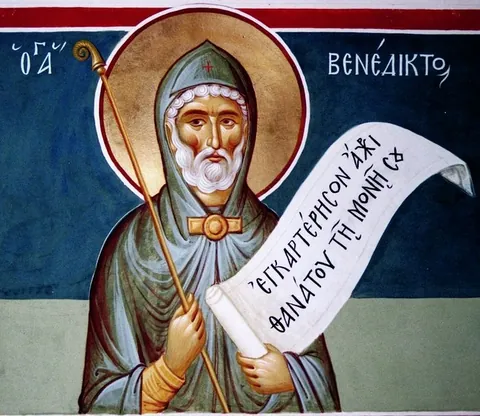
Venerable Benedict (+543)
The Venerable Benedict of Nursia (+543), founder of the Western monastic order of the Benedictines, was born in the Italian city of Nursia in 480. When the boy was fourteen his parents sent him to Rome to study, but, troubled by the immorality around him, he decided to choose another way of life. At first Saint Benedict went to the church of the holy Apostle Peter in the village of Effide, and then took refuge in the mountains. Here he met the hermit Romanus, who tonsured him a monk and showed him a cave where he was to live. From time to time the hermit brought the monk food. Saint Benedict spent three years in fierce struggle with temptations and overcame them. Soon people gathered round him who wanted to live in the desert under his guidance. The number of disciples grew so much that Saint Benedict divided them into twelve communities and appointed abbots for them. In each community there were twelve monks.
Not everyone liked the strict rules laid down by Saint Benedict, and the venerable father was often the object of groundless gossip and persecution.
At last he settled in Campania and on Mount Cassino founded the monastery of Monte Cassino, which for a long time was the centre of theological learning of the Western Church. In this monastery Saint Benedict, following the lives of the Eastern desert fathers and the rules of John Cassian the Roman (commemorated 29 February), compiled a monastic typikon, which was later adopted by many Western monasteries. The rule demanded of monks absolute self-denial, unquestioning obedience and constant labour. The elder monks were also charged with the upbringing of boys and with copying ancient manuscripts, which preserved for us many precious monuments of the first centuries of Christianity. Every newcomer spent a whole year under obedience, so as to learn the typikon and grow used to monastic life. Every task was to be done with a blessing. The head of the monastery was the abbot, who enjoyed unlimited authority. He judged, taught and instructed. The abbot took into account the advice of the older, experienced brethren, but made decisions alone. Keeping the typikon was binding on all. Saint Benedict’s labours were pleasing to the Lord, who rewarded him with the gifts of foresight and wonderworking. He foresaw his own death too.



