
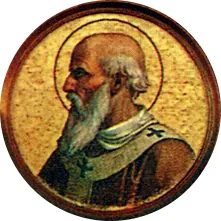
St Leo I, Pope of Rome (+461)
Saint Leo the Great, Pope of Rome (440–461), received an excellent and many-sided education, which prepared him for a brilliant secular career; but the young man, inclined to the spiritual life, chose another path: in the time of the holy Pope Sixtus III (432–440) he was ordained archdeacon, and after his death, in 440, he became Pope of Rome as well. At that time various heretical teachings were troubling the Church. The hierarch Leo showed wonderful firmness and steadfastness when it came to defending the confession of faith. In the name of the Orthodox Church he boldly exposed the heresies of Eutyches and Dioscorus, who preached that Christ has only one nature, and also the heresy of Nestorius; by letters sent to the Byzantine Emperors Theodosius II (408–450) and Marcian (450–457) he did much to bring about the convening of the Fourth Ecumenical Council of Chalcedon (451) to condemn the Monophysites. At the council, attended by 630 bishops, the hierarch Leo’s letter to the already deceased Patriarch of Constantinople Flavian (447–449), who had fallen victim to the Robber Council held in Ephesus in 449, was read. The pope’s letter set out the Orthodox teaching on the two natures of Christ, with which all the bishops taking part in the council agreed. The heretics Eutyches and Dioscorus were excommunicated. The holy pope also defended his homeland against barbarian attacks: in 452, by the power of his word, he calmed Attila, the fearsome commander of the Huns, who was prepared to ravage and lay waste Italy, and in 455 he persuaded Genseric, the leader of the Vandals, who had burst into Rome, not to destroy the city, not to burn its buildings and not to shed blood.
Pope Leo the Great lived to a deep old age. He sensed his approaching end beforehand and prepared for it with fervent prayers and good works.
The holy father died in 461 and was buried in Rome, in the Vatican basilica. His literary legacy includes 96 sermons and 143 letters.



