
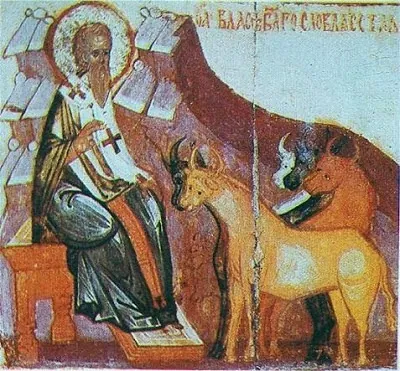
Hieromartyr Blaise, Bishop of Sebaste (+c. 316)
The Hieromartyr Blaise, Bishop of Sebaste, enjoyed universal love for his righteous and pious life, and so the inhabitants of the city of Sebaste unanimously chose him as their bishop. The holy hierarch’s ministry coincided with the reigns of the cruel persecutors of the Christians, Diocletian (284–305) and Licinius (307–324). He strengthened his flock, visited prisoners in the prisons, and encouraged the martyrs.
Many Christians avoided the lawless and hid in wild and secluded places. Blaise too was forced to take refuge on Mount Argeos and continue his labours there in a cave. The wild beasts of the forest came to the saint and waited obediently for him to finish his prayer so as to receive his blessing. The hierarch healed sick animals by laying his hand on them. Once the servants of the godless governor Agricolaus came upon the holy father’s refuge. Agricolaus ordered the fugitives to be seized, but those he sent found only the Bishop of Sebaste on the mountain. The holy father glorified the Lord and went with the soldiers.
On the way Blaise healed the sick and worked many miracles. In one place a poor widow complained to him that a wolf had carried off her only possession, a piglet. The bishop smiled and said to her: “Do not weep, your piglet will come back to you.” And indeed, to everyone’s amazement, the wolf came back out of the forest and handed its prey back unharmed to its owner.
Agricolaus met the holy father with flattery and fawning and called him a friend of the gods. The saint answered his greeting with a greeting, but called the pagan deities demons; for this he was cruelly beaten and thrown into prison.
The next day the blessed martyr was tortured again. When the tortured hierarch was being led back to prison, seven women followed him and gathered up the drops of his blood. The tormentors seized them and tortured them terribly, but, protected by the grace of God, the women courageously endured the torments. By the Lord’s will a visible miracle also took place: their bodies became white as snow, and milk gushed from their wounds. At last the holy martyrs were beheaded.
Saint Blaise was brought again to Agricolaus. Here he once more courageously confessed Christ. The governor ordered the blessed hierarch to be thrown into a lake, but the chosen vessel of God’s grace made the sign of the cross over the water and walked on it, and then said to the pagans standing on the shore: “Do you too call on your gods for help and come to me.” Sixty-eight chosen courtiers of the governor dared to imitate the martyr, but they all drowned as soon as they went into the water. Enraged at the death of his best servants, Agricolaus gave the order for the saint to be beheaded without delay. Before his death the blessed father commended to God the whole world, and especially those who would honour his memory. The holy hieromartyr met his end in 316. During the Crusades his incorrupt relics were carried off to the West, and today they are scattered among various countries of Europe.



