
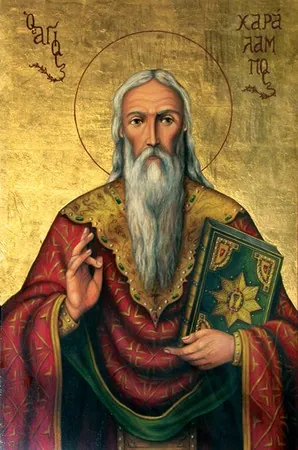
Hieromartyr Charalampus and the Martyrs with Him: Porphyrius, Baptus and Others (+202)
Saint Charalampus, Bishop of the Thessalian city of Magnesia (a region of north-eastern Greece), was an ardent preacher of the word of Christ. He converted many erring souls to the true faith. When this was reported to Lucian, the governor of the region, and to the military commander Lucius, they ordered the saint to be seized. At the tribunal Charalampus firmly confessed Christ and refused to offer sacrifice to the idols. In spite of his great age (he was already a hundred and thirteen), the blessed father was cruelly tortured: they tore his body with iron forks until they had flayed him from head to foot. During the torture the saint said to his tormentors: “Thank you, brothers, you have renewed my soul!”
Two soldiers who witnessed the old man’s patience and complete freedom from anger, Porphyrius and Baptus, openly confessed Christ, for which they were beheaded. Three women who witnessed the bishop’s sufferings also glorified the true God. The executioners did not spare them either: they were put to death in terrible torment.
The enraged Lucius himself seized the instruments and began to torture the martyr, but suddenly his arms were taken from him, as if cut off with a sword. The governor, coming to the place of torture, spat in the saint’s face with contempt, and for his insolence was punished at once: his head was turned round backwards. After Lucius had humbly asked the hierarch’s forgiveness, the venerable father prayed for the offenders and healed them both. Many who witnessed this miracle believed in Christ. Among them was Lucius too, who, tormented by pangs of conscience, fell at the old man’s feet and once more asked his forgiveness. Lucian reported what had happened to the Emperor Septimius Severus (193–211), who was at that time in Antioch of Pisidia (the western part of Asia Minor). The king ordered Charalampus to be brought to him. They tied a rope to the hieromartyr’s beard and dragged him along by it. Septimius wished the bishop to be tortured with still more terrible torments, and the executioners began to torture the martyr over fire. The Lord’s chosen one, clothed with the grace of the Holy Spirit, remained unharmed, and received the gift of wonderworking too: through his prayer a young man who had died was raised to life, and a man possessed, tormented by an evil spirit for thirty-five years, was healed.
The eyewitnesses of these wonders glorified the Lord with one voice. The emperor’s daughter Galina also believed in Christ the Saviour, and, moved by divine zeal, twice smashed the idols in a pagan temple. By the king’s order they struck Charalampus on the mouth with stones and wanted to set fire to his beard, but the flame that burst out from there burned the executioners themselves. The enraged Septimius Severus and one of his nobles, Crispus, blasphemed God and mockingly called on Him to come down to earth and boast here of His power and authority. Angered by such insolence, the Lord shook the earth, filled everyone with terror, and hung the two lawless men up in the air. Bound with invisible fetters, the blasphemers came down to earth only through the hierarch’s prayers. The frightened emperor seemed to feel the almighty power of the King of heaven, earth and the underworld and was ready to worship Him, but the evil one again darkened his mind, and, falling into a terrible rage, he ordered Saint Charalampus first to be tortured and then beheaded. During his last prayer the blessed hierarch was counted worthy of an appearance of the Saviour, and besought Him to grant peace and fruitfulness to the place where his body would be buried, and forgiveness of sins and salvation to its inhabitants. The blessed father reposed in peace before the death sentence was carried out. The emperor’s daughter Galina buried the body of Saint Charalampus with honour.



