
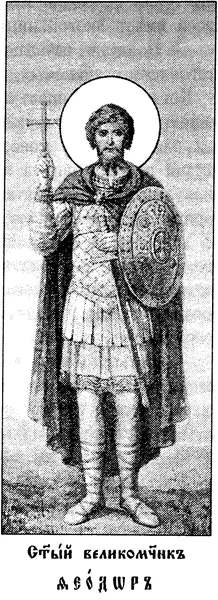
Holy Martyr Theodore Stratelates (+319)
The holy Martyr Theodore Stratelates lived in the city of Euchaita. He was endowed with many gifts and a fine appearance. The Lord also granted the compassionate soldier full knowledge of the Christian truths. The saint’s valour became known to all when, with God’s help, he killed a huge serpent nesting in a chasm near Euchaita, which mercilessly devoured people and terrified the population. For the courage he had shown Theodore was appointed stratelates in the city of Heraclea. The saint fervently preached the teaching of the Gospel among his pagan soldiers. His words, strengthened by the example of his own life, converted many of the godless to the true faith. Soon almost the whole of Heraclea became Christian. At that time the Emperor Licinius (307–324) began a cruel persecution of the Orthodox. He tried to stifle the most valiant defenders of Christianity, those who shone especially with divine grace, and so to behead the faith. One of these chosen ones was Theodore Stratelates. The saint himself invited Licinius to Heraclea and promised him that he would offer sacrifice to the gods. As if to perform this great ceremony, he gathered in his own house the gold and silver idols of the whole city. Blinded by hatred of Christianity, Licinius believed Theodore’s message, but he was cruelly deceived: the holy soldier smashed the statues of the false gods and gave away their fragments as alms. Theodore was seized and cruelly tortured: they stretched him on the ground, beat him with ox sinews, tore him with iron forks, tortured him over flames and put out his eyes. Then they kept him in prison for five days without food or drink, and at last nailed him to a cross. Awaiting his approaching end, the saint gave himself to prayer. But the Lord willed that Theodore’s death should be as miraculous as his whole life: He healed his wounds and took him down from the cross; the king’s soldiers saw the power of the true God, believed in Christ and were baptised. After this the saint did not wish to avoid a martyr’s death; he calmed the people who had risen up against the tormentors and gave himself up to Licinius of his own accord. On the way, by speaking a single word, he opened the doors of the prisons and freed the prisoners from their fetters. The sick and the possessed were healed at once by touching his garments and his miraculously healed body. By the king’s order the saint was beheaded. Before his death he said to his servant Uar, who was present and was writing down his martyrdom: “Do not be slack to record the day of my death, and bury my body in Euchaita”; with these words he asked for a yearly commemoration. Then the holy martyr said “Amen!” and willingly bowed his neck to the sword. This happened on 8 February 319, a Saturday, at the third hour of the day.



