
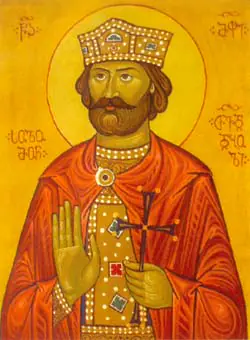
Holy King Solomon II, Who Laid Down His Life for His Homeland (+1815)
The holy King Solomon II (before his accession David son of Archil) was born on 7 (20) February 1772. His father was the brother of King Solomon I of Imereti (+1784), and his mother Elene was the daughter of King Erekle II of Kartli-Kakheti (+1798). David was brought up mostly in his mother’s family. Like the biblical David, the Lord chose him too in childhood, and King Solomon I of Imereti, left without an heir, by God’s providence bequeathed the throne to him while still living.
David grew up as a future king, one who sought to lay down his life for the faith and the homeland, a fighter for freedom.
David was twelve when King Solomon I of Imereti died. Against the king’s will the powerful lords of Imereti raised to the throne, instead of the young David son of Archil, David son of Giorgi (King David II). The disregard of the late king’s will caused unrest among the people. The princes discontented with the new king’s policy sought, according to Solomon I’s will, to set David son of Archil on the throne of Imereti. Unhappily this good attempt came to nothing.
In 1790, in the battle at Matkhoji, King David II was defeated, and David son of Archil ascended the throne — the holy King Solomon II.
The king set energetically about the struggle for the unity of the country; he married the daughter of Grigol Dadiani, ruler of Odishi, and Mariam Katsi; the principality of Guria was part of his kingdom, and he was bound by blood to the kingdom of Kartli-Kakheti. The confessor of Saint Solomon II was Saint Ilarion Kanchaveli. Their spiritual bond and their common view of the state brought about many good changes in the kingdom. To develop and strengthen the thinking of faith and of the state, the king strengthened the Church and advanced worthy people. King Solomon II rewarded princes loyal to the country with his own estates, confirmed to the Church of Jerusalem its estates and dues in Imereti, and renewed the charter of the church of Bichvinta...
After the kingdom of Kartli-Kakheti was joined to Russia, the Russian government sought by every means to annex the kingdom of Imereti as well. The perceptive and far-sighted Saint Solomon saw clearly that the idea of freeing and uniting the country was gradually being shattered against historical reality; Solomon tried to preserve the freedom of the kingdom of Imereti, but the saint’s political manoeuvring between Russia and the Ottoman Empire ended in failure. By order of the Russian Emperor Alexander I, on 20 February 1810 Saint Solomon II was deposed, and Russian rule was proclaimed in Imereti.
Saint Solomon II was seized by deceit and taken to Tbilisi, but the king managed to escape and took refuge in the pashalik of Akhaltsikhe, from where he led the national liberation movement. The Russian government again drowned in blood the Imeretian uprising of 1810, and Saint Solomon II again took refuge in Akhaltsikhe, from where he crossed into the Ottoman Empire. Saint Solomon lived for seven years in the city of Azmur, and then moved to Trebizond, where the pasha there, by origin a Georgian prince, received him with honour.
There survives a Greek Gospel bound in gold, offered by Solomon II to the Greek church of Trebizond, with the inscription: “Offered to Saint George who lies here, this holy Gospel, by Solomon the Second, king of all Imereti, son of Kartli”; on another page the king’s confessor Iese Kanchaveli (Saint Ilarion the Georgian) is mentioned. While in exile Saint Solomon II fought without rest for the freeing of the country, which of course he did not live to see in this world. He died in Trebizond on 7 (20) February 1815 and was buried within the enclosure of the Greek church.
Saint Solomon II was canonised on 27 July 2005 by the Holy Synod of the Church of Georgia, and before that the remains of Saint Solomon II were brought from Trebizond and buried in the monastery of Gelati.



