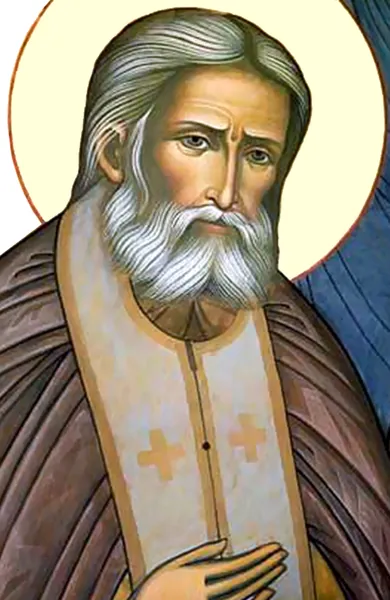
Venerable Seraphim of Sarov the Wonderworker (+1833)
The Venerable Seraphim of Sarov (in the world Prokhor Moshnin), one of the greatest saints of the Russian Church, was born in Kursk on 19 July 1754. His father Isidore died early, and the little boy was left in the care of his mother Agathia.
From childhood the Lord guarded His chosen vessel of grace. Once the boy fell from the high bell tower of a church under construction, but survived unharmed; then he fell mortally ill, but in his sleep he saw the Theotokos, who promised to visit and heal him. And indeed, soon a procession with crosses and an icon of the Theotokos passed in front of their courtyard. His mother ran out carrying the child in her arms and touched him to the icon, after which he quickly began to recover.
Prokhor had a remarkable memory. He learned to read and write easily. From childhood he loved to attend divine services and to read Holy Scripture and the lives of the saints to other children, but most of all he was drawn to solitary prayer and to the understanding of the truths of the Gospel.
While still young Prokhor decided to dedicate himself to the service of the Lord and to go to a monastery. His pious mother blessed his intention and gave him a cross, which the saint wore on his breast all his life. Soon, together with other believers, Prokhor walked from Kursk to Kiev to venerate the holy things of the Caves. The schemamonk Dositheus advised him to settle in the Sarov hermitage. Returning home, the God-loving young man said farewell for ever to his mother and relatives, and on 20 November 1778 arrived in Sarov, where at that time the superior was the elder Pachomius, shining with wisdom. He received Prokhor warmly and assigned the elder Joseph to him as his teacher. The new novice carried out every task with joy and laboured so diligently, as if he were serving the Lord Himself. By constant work he guarded himself against despondency, which, as he later remarked, is the most dangerous temptation.
In these same years Prokhor, imitating other ascetic monks, received a blessing for solitude and prayer in the forest. Two years later the young novice fell ill with dropsy; his whole body swelled and he suffered terribly; he was ill for three years, but would not let a doctor near him. “I have entrusted myself to the true Physician of soul and body, our Lord Jesus Christ, and to His All-pure Mother,” he told Father Pachomius, and asked for Communion. And lo, then the Theotokos appeared to him, accompanied by the Apostle Peter and John the Theologian. The Most Holy Virgin touched the sick man’s side with a staff; from openings that miraculously appeared the fluid gathered in his body slowly began to flow out, and soon the saint was completely well.
The saint spent eight years in the Sarov monastery as a novice, and then was tonsured a monk and named Seraphim, a name that truly befitted his soul, burning with divine love. A year later Seraphim was serving in church, and even after the services he prayed unceasingly. More than once the Lord counted him worthy of divine visions: during the services Seraphim clearly saw angels. The holy father was filled with special grace by an appearance of the Saviour Himself at the Divine Liturgy on Great Thursday. After this vision he made his labours stricter: in the morning he worked in the monastery, and at night he prayed in a solitary cell in the wild forest. In 1793, at the age of thirty-nine, Seraphim was ordained hieromonk. Soon the superior of the monastery, Father Pachomius, reposed. Before his death he gave the saint his blessing for the life of a hermit. Seraphim also received a blessing from the new superior, Father Isaiah, and withdrew to a cell a few kilometres from the monastery, in the dense forest. For whole weeks he prayed here, and came to the monastery only on Saturdays, before Vespers, returning after the Liturgy, strengthened by Communion of the Saviour’s Body and Blood. The venerable father lived in strict labour: he composed his rule on the model of the rules of the ancient desert monasteries. He always carried the holy Gospel with him. In the course of a week he would read through the New Testament. Besides this, he read the works of the holy fathers and the service books. Seraphim learned many hymns by heart, and while working in the forest offered up his prayers in song. Near his cell he laid out a vegetable garden and kept bees too; he earned his bread by his own work, but ate very little, taking food only once a day, and on Wednesdays and Fridays taking nothing at all. In the first week of Great Lent he ate nothing until Saturday, and on Saturday received the Holy Mysteries.
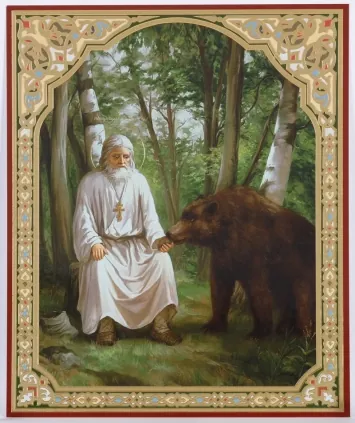
Not only the brothers of the monastery but lay people too began to come more and more often to Saint Seraphim to ask for counsel and blessing. This disturbed his quiet, and so, with the superior’s blessing, the saint forbade first women and then everyone else to come to him. Through Seraphim’s prayer the path to his cell became blocked by the thick branches of hundred-year-old pines. Now only birds and beasts could reach the holy father. He fed a bear with his own hand when bread was brought to him from the monastery.
The Venerable Seraphim’s valiant labours were an eyesore to the enemy of the human race, the devil. He intensified his struggle against the saint: first he tried to frighten him, then he tried to trouble his mind with evil thoughts. The venerable father decided to make his labours still stricter: every night he climbed onto a huge stone and prayed with uplifted hands: “O Lord, have mercy on me a sinner.” By day he continued his prayer in his cell. Here too he stood on a stone brought from the forest, from which he seldom came down. So the saint prayed for a thousand days and nights. Once robbers came upon the monk as he was working in the wilderness and demanded money. The robbers beat the venerable father cruelly, broke his head, broke his ribs, and then tied him up and were about to throw him into the river; but when, after thoroughly searching his poor cell, they found nothing in it but an icon and a few potatoes, they went away from the place in shame. The Theotokos healed the saint of his terrible wounds by appearing to him. After this Seraphim always walked bent double, leaning on a staff or an axe; but he forgave those who had injured him from his heart and asked that they not be punished.
When Hegumen Isaiah died, the holy father took on the labour of silence. He tried by prayer to cleanse his mind of every vain thought: if he met anyone in the forest, he would fall on his face and not get up until the one he had met had gone. The saint spent almost three years in this labour, not even going to the monastery for the Sunday Liturgy. Then the new hegumen, Nifont, and the brothers of the monastery asked the elder at least to come to them for the services, or else to return to the monastery altogether. The venerable father chose the latter, because he found it hard to walk the long distance, and in the spring of 1810, after fifteen years as a hermit, he returned to the monastery. Here he shut himself up in a cell from which he never came out. For his long and diligent labours the Lord granted the zealous monk the gifts of clairvoyance and wonderworking. On 25 November 1825 the Theotokos appeared to him and called him to the service of the people, and from that day the door of the saint’s cell was open to all who wished to come. The elder saw into the hearts of those who confessed to him, and by prayers offered to God healed them of illnesses of soul and body. The saint cared especially for his beloved Diveyevo convent. In the last years of his life he was even seen raised up in the air during prayer.
In the last year of his life Seraphim of Sarov grew noticeably weaker, and spoke much about his approaching end. At that time he was often seen standing at the door of his cell by the coffin he had had made for himself with his own hands; the venerable father asked to be buried by the altar of the Dormition church, in a place he had pointed out beforehand. On 1 January 1833 he received Communion for the last time. On 2 January, towards six in the morning, the saint’s novice Paul smelled burning coming from his cell. The saint always kept candles burning, but he used to say: “As long as I am alive there will be no fire in my cell; my death will be revealed by fire.” When they opened the door, they saw that books and other things had caught fire, while Father Seraphim, kneeling before the icon of the Theotokos, had committed his soul to the Lord.